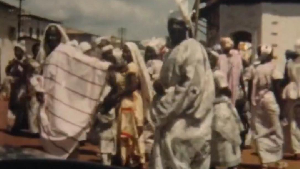
An archival video has surfaced showing how natives of Saltpond in the Central Region of Ghana celebrated the country’s independence in 1957.
The footage was filmed by Scottish teacher Wilma Gladstone and captures the atmosphere in the coastal town at the moment Ghana gained freedom from colonial rule.
The video, which was shared on X by Fante Asafo Flags, documents scenes of jubilant Ghanaians in both traditional cloth and Western-style clothing celebrating the historic moment.
In the footage, large crowds gather in the streets in a festive mood. There are street parades and lively processions featuring marching bands, dancers, and schoolchildren moving through the town.
Residents can be seen cheering, singing, and dancing as they mark the birth of the new nation.
The celebrations also include drumming and spontaneous gatherings in different parts of the town, with people openly expressing their excitement at the end of British colonial rule.
Sankofa Series: How the tree-trunk design inspired the unique edifice at Nkrumah Park
The video provides a rare glimpse into how ordinary Ghanaians in Saltpond experienced and celebrated the country’s independence in 1957.
Saltpond holds a huge place in Ghana’s political history. The town’s prominence dates back to the early 20th century when it became an important center in the Ghana’s growing independence movement.
It was in Saltpond in 1947 that the United Gold Coast Convention (UGCC) was founded, becoming the first major political organisation to openly challenge British colonial rule and demand self-governance for the Gold Coast.
The driving force behind the UGCC was businessman George Alfred Grant, widely known as Paa Grant.
A timber magnate and one of the “Merchant Princes of the Gold Coast,” Paa Grant became concerned about the exploitation of his fellow citizens under colonial rule and saw the need for a political movement to advocate for their rights.
He invited several influential leaders, including JB Danquah, to his home in Saltpond. During this meeting, the foundation for the UGCC was laid, along with the party’s bold declaration that “the control and direction of government shall, within the shortest time possible, pass into the hands of the people and their chiefs.”
Although the UGCC’s early efforts were later overshadowed by the rise of Kwame Nkrumah and the Convention People’s Party (CPP), Paa Grant’s role in igniting Ghana’s independence struggle remains significant.
Before his death in 1956, Paa Grant personally financed the CPP and also played a key role in recruiting Nkrumah to serve as the UGCC’s General Secretary, a decision that would later shape the direction of Ghana’s independence movement.
Saltpond, the town that shaped Ghana's Independence. Filmed during celebrations in 1957 by Scottish teacher Ms Wilma Gladstone 🇬🇭 pic.twitter.com/fZA0eJnUDg
— Fante Asafo Flags (@AsafoFlags) March 7, 2026
Watch the 2025 GhanaWeb Excellence Awards below:
AK/MA