Ghana’s Vice President, Professor Jane Naana Opoku-Agyemang, has called for renewed and decisive action to enhance the participation of women and young people in governance across West Africa, stressing that inclusive leadership is critical to the region’s democratic and development agenda.
She delivered the call at the closing ceremony of a four-day Regional Consultation on Political Participation and Leadership of Women and Youth in West Africa on February 20, 2026.
The meeting formed part of the Legacy Project under the Economic Community of West African States (ECOWAS) Commemorative Project on Gender Parity in Elected Bodies in Member States (2025–2035), held in Accra.
Prof Opoku-Agyemang acknowledged that West Africa has adopted key instruments such as the ECOWAS Gender Policy and the ECOWAS Protocol on Democracy and Good Governance to promote democratic inclusion and gender equality.
However, she noted that despite these frameworks, women and youth remain significantly underrepresented in political and decision-making spaces across many member states.
According to her, "the region’s progress depends on its ability to harness the potential of all citizens."
Veep shares leadership insights with women in media
She cautioned that continued exclusion weakens democratic institutions and undermines sustainable development.
Highlighting Ghana’s efforts, the Vice President referenced the passage of the Affirmative Action Act as a landmark step toward improving women’s representation in governance.
She pointed out that "women currently hold strategic positions across ministerial, parliamentary, judicial and local government institutions, demonstrating Ghana’s commitment to inclusive leadership."
She also emphasised initiatives aimed at empowering young people, including programmes led by the Ministry of Youth Development and the National Youth Authority, which have expanded youth engagement in civic education, policy dialogue and national decision-making processes.
While admitting that challenges persist, Prof Opoku-Agyemang reaffirmed Ghana’s readiness to collaborate with ECOWAS and fellow member states to exchange best practices and strengthen cooperation in pursuit of gender parity targets between 2025 and 2035.
She urged governments and development partners to translate policy commitments into concrete action, stressing that inclusion must be institutionalized within political systems.
Vice President of the ECOWAS Commission, Damtien Tchintchibidja, reiterated the Commission’s dedication to supporting member states in expanding opportunities for women and youth in governance.
In her closing remarks, she highlighted the need for equitable access to resources, effective monitoring and evaluation systems and sustained efforts to address socio-cultural barriers that hinder participation.
She described these measures as essential to embedding inclusion within the democratic structures of member states.
Vice President Tchintchibidja commended the Government and people of Ghana for hosting the consultation and expressed appreciation to Prof Opoku-Agyemang for the hospitality extended to delegates.
The ECOWAS Commission Vice President noted that the initiative brought together multiple institutions, including the ECOWAS Community Parliament and female parliamentarians of ECOFEPA, the Community Court of Justice, and several technical directorates.
She also cited the involvement of the ECOWAS Youth and Sports Development Centre, the Directorate of Political Affairs, the Early Warning Directorate and the Human Capital Development Unit as evidence of the cross-cutting nature of political inclusion.
AM
Meanwhile, watch GhanaWeb’s exposé on the 'dark side of Kayamata' and its devastating impact
General News of Friday, 20 February 2026
Source: www.ghanaweb.com
VP Opoku-Agyemang urges stronger push for women, youth inclusion
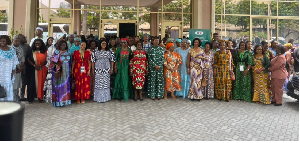 Professor Jane Naana Opoku-Agyemang among other stakeholders pose for a picture