The Institute for Democratic Governance (IDEG) and the Civic Forum Initiative (CFI) have issued a strong warning over what they describe as the growing commercialisation of Ghana’s electoral process, cautioning that democratic elections risk being reduced to “plutocratic auctions.”
In a press release issued on February 13, 2026, the two civil society organisations expressed “grave concern” about the persistent trend of vote selling and buying in Ghana’s elections, a situation they say was “openly highlighted in the recent NDC parliamentary primaries conducted ahead of the Ayawaso East constituency by-election scheduled to be held on March 3, 2026.”
According to IDEG and CFI, the reactions from some political actors suggest a dangerous shift in public attitude.
“Some of the public reactions emanating from some leading players in Ghana’s political arena would seem to suggest that the practice of vote selling and buying has become so widespread in our democratic political practice that it should be accepted as the new normal,” the statement said.
But the groups insist this cannot be allowed to stand. “Voting and buying are so injurious to our nascent democracy that they should not and cannot be accepted as a standard practice in any democratic political culture,” they stressed.
The organisations attribute the problem to what they describe as a broken relationship between political leaders and citizens.
“What is consistently driving the commercialisation of our electoral politics is the total lack of a strong values-based bond between voters and the political class in Ghana, as well as, the near-total absence of servant leadership in our political system,” the statement noted.
They argue that this vacuum has created a toxic political environment.
“This vacuum has been filled with the monetisation of electoral politics, whereby voters offer their votes in exchange for financial and material rewards, and election candidates, in turn, sharing no values with the electorate, are convinced that offering voters monetary and material incentives is the surest way to enlist their electoral loyalty,” it added.
The groups further warned that in such an atmosphere, enforcement becomes nearly impossible.
“In this toxic environment, rules and regulations on vote selling and buying, bribery and treating, count for nothing, as institutions charged with enforcement inevitably become weak and ineffective,” they said.
IDEG-CFI maintained that Ghana’s democratic credentials are at stake.
“Ghana’s reputation as a leading African democracy is too valuable to be left to be tainted by corrupt occurrences of the kind recorded in Ayawaso East NDC parliamentary primaries and similar elections,” the statement asserted.
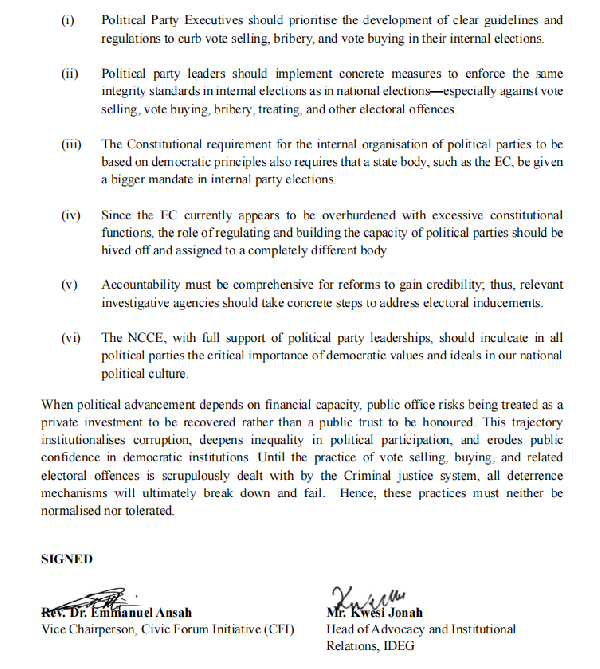
To address the situation, the organisations proposed a series of reforms, including stricter internal party guidelines, stronger enforcement of integrity standards, and expanded oversight of internal party elections by the Electoral Commission.
link text
They also called for comprehensive accountability, stating that “relevant investigative agencies should take concrete steps to address electoral inducements,” and urged the National Commission for Civic Education to intensify efforts at promoting democratic values within political parties.
Perhaps most strikingly, the groups warned of the long-term consequences if the trend continues.
“When political advancement depends on financial capacity, public office risks being treated as a private investment to be recovered rather than a public trust to be honoured,” the statement cautioned. It added that such a trajectory “institutionalises corruption, deepens inequality in political participation, and erodes public confidence in democratic institutions.”
The statement concluded with a firm call for decisive action: “Until the practice of vote selling, buying, and related electoral offences is scrupulously dealt with by the Criminal justice system, all deterrence mechanisms will ultimately break down and fail. Hence, these practices must neither be normalised nor tolerated.”
The statement was jointly signed by Rev Dr Emmanuel Ansah, Vice Chairperson of CFI, and Kwesi Jonah, Head of Advocacy and Institutional Relations at IDEG.
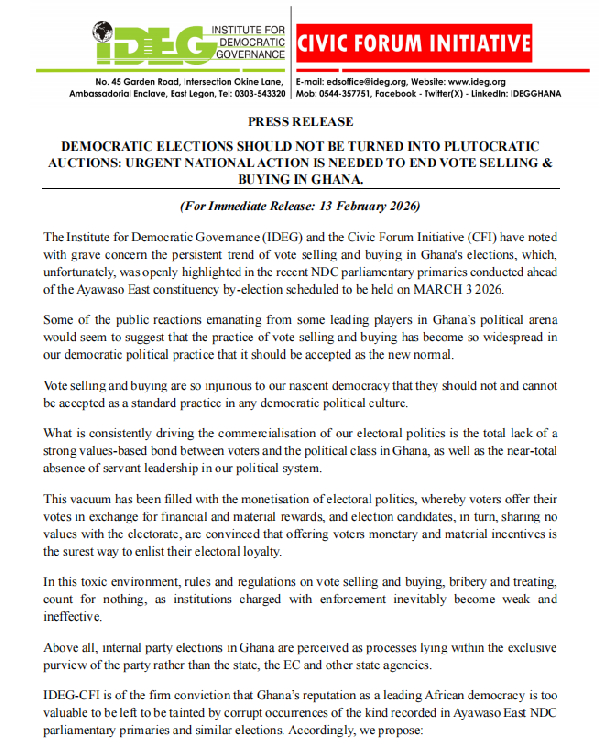
See the statement below:
NA/VPO
Family announces funeral plans for former Radio Univers boss Alhaji:
General News of Tuesday, 17 February 2026
Source: www.ghanaweb.com
IDEG, CFI raise alarm over vote buying ahead of Ayawaso East by-election
 File photo of an election booth