President John Dramani Mahama has urged the strict enforcement of laws against the indiscriminate felling of shea trees, which is considered a criminal offense under Ghanaian law.
But what many people may not be aware of is that there are several laws and Legislative Instruments (LIs) that protect trees and plants from illegal exploitation, aimed at preserving endangered species, and to safeguard cultural heritage.
Curator, another arrested over unauthorized felling of treasured trees in Aburi Botanical Gardens
These laws managed by the Forestry Commission include the Economic Plants Protection Act, 1979 (AFRCD 47), Trees and Timber Act, 1974 (NRCD 273) among others.
Economic Plants Protection Act, 1979 (AFRCD 47)
Under this act, the destruction of specified plants of economic value is prohibited, along with other related matters.
The act states that anyone who intentionally destroys, or causes the destruction of a specified plant without the written authority of the minister, or for purposes other than horticultural husbandry, commits an offense.
The penalties for persons convicted include, for each offense, a fine not exceeding two hundred and fifty penalty units, a term of imprisonment not exceeding three months, or both the fine and imprisonment.
Some of the protected tree species under these laws are:
Rosewood (Pterocarpus erinaceus), Afrormosia/Kokrodua (Pericopsis elata), African Mahogany (Khaya spp.), Iroko/Odum (Milicia excelsa/regia), Makore/Baku (Tieghemella heckelii), Sapele/Sapelewood (Entandrophragma cylindricum), Ovangkol/Hyedua (Guibourtia ehie).
Others are Cocoa trees, Shea trees, Dawadawa, Baobab tree, Tamarind.
Trees and Timber Act, 1974
This act provides for the registration of locality marks, the felling for export and for related matters.
Section 2 of the Act indicates that “A person shall not cut or fell a growing tree for export in log form or for conversion in a mill unless that person has first registered a property mark at the office of the Executive Director, Forests Division of the Forestry Commission, endorsed for the locality in which that person proposes to cut or fell”.
Section 3 which deals with the export of logs, states that, “A person shall not export a log unless it is marked with the cutter's property mark registered at the office of the Forestry Commission.”
For offenses listed under this act, the penalty includes a fine, a term of imprisonment, or both.
It states, “(I) A person who contravenes or fails to comply with a provision of this Act, commits an offence and is liable on summary conviction to a fine not exceeding one thousand penalty units or to a term of imprisonment not exceeding five years or to both the fine and the imprisonment. (2) Where a stump or log has been marked with a registered property mark, the onus of proof that it has been marked in accordance with this Act shall be on the registered holder of the property mark.
Felling of trees along Atomic-Kwabenya highway 'an environmental sabotage' – A Rocha Ghana
“(3) Where a person is convicted of an offence under subsection (I) the Court may in addition to the punishment imposed, order that the whole or a part of the trees or timber in respect of which the offence was committed shall be forfeited and disposed of as the Court may direct, and may order that a licence or permit held under this Act or the Regulations by the person convicted shall be forfeited. (4) Where a person is convicted of an offence under subsection (I), the Chief Conservator of Forests may cancel the registration of the relevant property mark.”
MAG/AE
Understanding Ghana's stock market and how to invest | BizTech
General News of Thursday, 5 February 2026
Source: www.ghanaweb.com
12 trees and plants protected by law against felling in Ghana
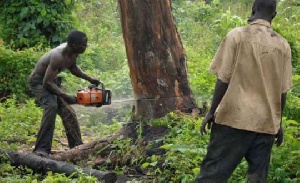 Felling trees without authorisation is a criminal offense