The government has laid a new Minerals (Royalties) Pricing Schedule Regulation, introducing a sliding-scale royalty regime for gold, lithium and other minerals mined in Ghana before Parliament.
The regulation is in accordance with Regulation 2(1) of the instrument is intended to align Ghana's mineral royalties with prevailing international market prices, ensure fairer returns to the state during periods if high commodity prices, promote transparency in the determination of mineral values.
Gold royalties will no longer be charged at a flat rate under the new regime but will vary depending on international prices.
Speaking to the media in Parliament on December 19, 2025, the Minister of Lands and Natural Resources, Emmanuel Armah-Kofi Buah said where gold price is up to $1,900 per ounce, a royalty rate of 5 percent will apply.
He explained that the rate increases progressively to 6 percent when prices rise above US$1,900 to US$2,000, 7 per cent for prices between US$2,000 and US$2,500, and 8 percent for prices above US$2,500 to US$3,000.
10% royalty in Ghana's lithium deal was unlawful - Majority
"The royalty rate climbs further to 9 per cent for prices above US$3,000 to US$3,500, 10 per cent between US$3,500 and US$4,000, 11 per cent between US$4,000 and US$4,500, and caps at 12 per cent when gold prices exceed US$4,500 per ounce," he said.
According to him, the sliding-scale model has been introduced in the Ewoyaa Lithium agreement with Barari DV which has been relayed before Parliament.
He said the new sliding-scale Ghana's lithium royalties will bbe charged at 5 percent when are up to $1,500 per tonne, rising to 7 per cent for prices between $1,501 and $2,500.
Buah further emphasized that the new pricing framework reflects the government's efforts in ensuring Ghana benefits from its natural resources.
SP/EB
All you need to know about Ghana's new vehicle number plates |BizTech:
Business News of Saturday, 20 December 2025
Source: www.ghanaweb.com
Government introduces sliding-scale royalty regime for its natural resources
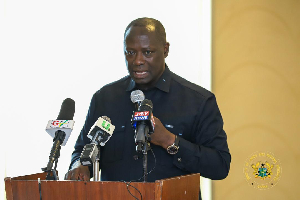 Emmanuel Armah-Kofi Buah is the Minister of Lands and Natural Resources


Entertainment