Ghana has strengthened its position as a continental leader in market-based climate action with the launch of a $200 million National Clean Energy Programme (NCEP), the country’s first clean energy project implemented under Article 6 of the Paris Agreement.
The landmark programme, launched in partnership with the Government of Switzerland, represents a major milestone in Africa’s participation in international carbon markets and global efforts to cut greenhouse gas emissions through cooperative approaches.
The NCEP, spearheaded by the KliK Foundation in collaboration with Ghana’s Environmental Protection Authority (EPA) and the Ministry of Energy and Green Transition (MoEnGT), seeks to expand access to renewable energy while delivering verified carbon credits that will contribute to both Ghana’s and Switzerland’s climate targets.
The programme will mobilize about $200 million in investment to develop 4,000 rooftop solar photovoltaic (PV) systems across the country, totaling 137 megawatts (MW) of clean energy capacity. The initiative will also stimulate private sector participation, local innovation, and green job creation.
At the launch event in Accra, Felix Addo-Okyeireh, Deputy Executive Director of the EPA, said the programme was a tangible outcome of Ghana’s commitment to the Paris Agreement and its strategic use of Article 6 mechanisms to attract climate finance.
“This programme demonstrates how Ghana is leveraging international carbon markets to achieve real, measurable, and credible emission reductions,” he said. “It is a significant step forward in our national climate ambition and our transition to clean energy.”
Addo-Okyeireh noted that Ghana’s partnership with Switzerland began in 2020 through the signing of one of the world’s first bilateral climate cooperation agreements, ratified by Parliament. This paved the way for a series of mitigation projects, including the Solar Rooftop Programme launched under the NCEP.
In an address delivered on his behalf, John Abdulai Jinapor, Minister for Energy and Green Transition, said the initiative was consistent with Ghana’s Energy Transition Framework, which charts a pathway to net-zero emissions by 2070 and targets 10 per cent renewable energy integration by 2030.
“The National Clean Energy Programme demonstrates that international cooperation can deliver concrete climate solutions,” Mr. Jinapor said. “It supports our NDC goals while creating jobs, promoting innovation, and driving sustainable development.”
He said the Ministry was updating the Renewable Energy Master Plan (REMP) to guide investments between 2026 and 2030 and had established a Renewable Energy Investment and Green Transition Fund to attract private capital and promote local solar manufacturing.
Ms. Simone Giger, Switzerland’s Ambassador to Ghana, Benin, and Togo, said Ghana was among the first countries in the world to operationalize an Article 6 agreement, highlighting its leadership in Africa’s clean energy transformation.
“This partnership is a model of how ambition can be turned into action,” she said. “Ghana is climbing the right tree — the tree of clean and sustainable energy — and Switzerland is proud to lend its push through partnership, investment, and shared expertise.”
She noted that while 90 per cent of Ghanaians now have access to electricity, about 64 per cent of generation still depends on fossil fuels — a trend that underscores the urgency of accelerating the transition to renewable sources.
The NCEP will deliver verified emission reductions that count toward Ghana’s updated Nationally Determined Contributions (NDCs), which aim to reduce 64 million tonnes of CO₂ equivalent by 2030.
As the first rooftop solar PV programme under Article 6 in Ghana, and the second of its kind globally, the NCEP positions Ghana as a frontrunner in climate cooperation, showcasing how international partnerships can drive sustainable growth and deliver measurable environmental results.
All you need to know about Ghana's new vehicle number plates |BizTech:
Business News of Tuesday, 28 October 2025
Source: GNA
Ghana secures $200m Swiss partnership to boost carbon market leadership
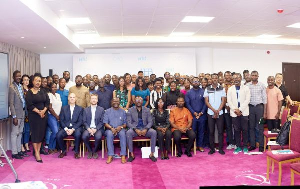 Stakeholders pictured at the launch of the National Clean Energy Programme