Deputy Minister of Finance, Thomas Nyarko Ampem, has reaffirmed government’s commitment to transforming Ghana’s public procurement system as a key driver of President John Dramani Mahama’s economic reset agenda.
Speaking at the National Procurement and Supply Conference, Nyarko Ampem noted that since procurement represents a significant share of national spending, it must deliver value-for-money and support long-term development.
“Procurement is not just about transactions. It is at the heart of development outcomes, job creation, climate resilience, fiscal discipline and public trust,” he said.
The Deputy Minister highlighted troubling inefficiencies in the past, referencing findings from IMANI-Ghana, ACEP and the Ghana Institute of Procurement and Supply (GIPS), which revealed billions of cedis lost annually to irregularities such as unauthorized procurements, poor supervision and biased tendering.
He warned that such leakages divert funds that should be building hospitals, schools, and resilient infrastructure.
To address these gaps, government has amended the Public Procurement Act to ensure all procurements backed by central government must have commencement certificates and budgetary provisions.
Government moves to curb GH¢2.36bn annual losses in procurement – Ampem Nyarko
Additionally, a Public Financial Management (PFM) Compliance Division has been operationalized to enforce adherence through the Ghana Electronic Procurement System (GHANEPS).
Nyarko Ampem also disclosed that Cabinet was considering the long-awaited Procurement Practising Bill, which aims to professionalize the function, curb malpractices and embed climate and sustainability considerations into procurement processes.
“This legislation will raise standards and give procurement the strategic importance it deserves,” he said.
He emphasized that the reforms align with the philosophy of the 24-Hour Economy Programme, aimed at reducing imports of goods that can be produced locally, promoting green procurement, and deliberately supporting local suppliers to create jobs.
“Every contract awarded to a capable Ghanaian company creates jobs that endure beyond a single project. Every insistence on local content builds industries that can compete across Africa and beyond,” he added.
SP/EB
Business News of Sunday, 21 September 2025
Source: www.ghanaweb.com
Procurement reforms to anchor Mahama's economic reset agenda - Nyarko Ampem
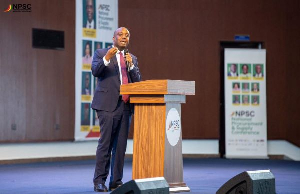 Thomas Nyarko Ampem is the Deputy Minister of Finance