One of the issues that remains a matter of public debate following Chief Justice Getrude Torkornoo's removal is whether she will receive her pension and other benefits as an Article 71 office holder, popularly termed as ex gratia.
Some persons, including legal practitioners, have argued that Justice Torkornoo would not get her ex gratia but is entitled to her pension. Others have argued that she will get nothing from the state.
According to reports, Justice Torkornoo has engaged President John Dramani Mahama, through some prominent Ghanaians, to plead with the president to allow her to retire in order to protect her end-of-service benefits.
At a press briefing in June 2025, Torkornoo indicated that one of the reasons she would not resign from her post was that “a judge who resigns or retires would lose all entitlements because they failed to defend the claims against them and resigned or retired while proceedings were still ongoing.”
Now, what does the law of the country say? Is the sacked Chief Justice going to lose all her entitlements after several decades of service to the country? Has there been any precedent?
FULL TEXT: Read leaked termination letter of Justice Torkornoo
The benefits of the Chief Justice:
First of all, what are the benefits of a Chief Justice?
Article 155 of the 1992 Constitution of Ghana outlines the end-of-service benefits of Superior Court justices, including the Chief Justice.
Per the provision in the Constitution, the Chief Justice is supposed to retire on her salary, which is subject to increases in the salaries of sitting justices.
“Notwithstanding, the provisions of this Chapter, a Justice of the Superior Court of Judicature who has attained the age of sixty years or above shall, on retiring, in addition to any gratuity payable to him, be paid a pension equal to the salary payable for the time being to a Justice of the Superior Court from which he retired,” part of Article 155(1) reads.
How the benefits of the Chief Justice are determined:
As pointed out in the previous section, Chief Justices are expected to retire on their salaries, but how are these salaries determined?
According to Article 71 of the Constitution, the "salaries” of Chief Justices and other Superior Court justices, which include allowances, facilities, privileges, and retiring benefits or awards, are to be determined by the President on the recommendations of a committee.
The committee should constitute not more than five persons appointed by the President, acting in accordance with the advice of the Council of State.
Read Justice Torkornoo's full response to Daniel Ofori's petition
How much the Chief Justice earns:
Renowned US-based Ghanaian lawyer and scholar, Professor Stephen Kwaku Asare, popularly known as Kwaku Azar, recently disclosed that Court of Appeal judges currently earn GH¢62,000 per month as salaries, aside from the other monthly benefits they enjoy.
"Let's do the mathematics. The current monthly salary for a Justice of the Court of Appeal is GH¢62,202.53," he wrote.
The Chief Justice, being a Superior Court judge like the Court of Appeal, should have had a monthly salary around the same range, if not higher.
Kwaku Azar also stated that in addition to the fact that Superior Court justices retire on their salaries, they are given ex gratia of over GH¢6 million.
"Upon retirement, the justice continues to receive this amount every month for life and that amount is automatically adjusted upwards any time salaries of sitting justices are increased.
In effect, the pension is indexed not to inflation but to salary growth, which is even more generous.
"On top of this, the justice receives a gratuity (aka ex gratia) equivalent to four months’ salary for every year served. If they served for 25 years (a not uncommon scenario), the mathematics is staggering: 4 x 25 x 62,202.53 = ¢6,220,253. Yes, over six million cedis paid as a lump sum upon retirement. This is in addition to a lifetime pension that starts at over ¢746,000 annually, with built-in upward adjustments," he added.
Conditions under which Superior Court judges would be denied their benefits:
Article 155 of the 1992 Constitution states the conditions under which Chief Justices and other Superior Court judges would be denied their retirement benefits.
First of all, before a judge qualifies to receive these benefits, s/he must have served a continuous term of ten years before retirement as a Justice of the Superior Court, or must have been in public service for over 25 years, out of which the person served as a justice for 5 years.
“(a) he has served for ten continuous years or more as a Justice of the Superior Court of Judicature; or
“(b) he has served for twenty years or more in the public service for at least five continuous years of which were as a Justice of the Superior Court of Judicature; and upon retirement under this clause, he shall not hold any private office of profit or emolument, whether directly or indirectly,” part of Article 155(1) reads.
Precedent:
Has a Superior Court justice of the country been denied these benefits before?
In March 2008, the Supreme Court ruled that a High Court judge, who was convicted for investing over $50,000 meant for a litigant, Justice Edward Boateng, had no legal basis to lay claims for his pension.
Stripped of the retirement package, Justice Boateng initiated a legal action at the High Court.
The case sought for interpretation at the Supreme Court, since the matter bordered on constitutional aspects linked to impeachment and the gratuity enjoyed by justices of the Superior Court.
The specific constitutional provisions referred to were Article 146(10), which stipulates how a Superior Court judge can be removed, and Article 155(1), which covers the retirement package for Superior Court judges.
In their argument before the court, lawyers for Justice Boateng had argued that the former High Court judge was on retirement when he was convicted, and therefore, he was entitled to his retirement package notwithstanding the conviction.
However, the seven-member panel of the Supreme Court, chaired by the then Chief Justice Sophia Akuffo, which had the following members: Justice Sule Gbadegbe, Justice William Atuguba, Justice Sophia Adinyira, Justice Jones Dotse, Justice Vida Akoto-Bamfo, and Justice Gabriel Pwamang, threw out the case of the dismissed High Court judge.
The Supreme Court ruled that Justice Boateng, although retired on December 11, 2011, and convicted on July 19, 2013, was interdicted on May 10, 2005, after he was charged with the offences.
In view of that, the court held that the former judge never retired from service, because his service was brought to an end when he was interdicted.
"Having been convicted of the offence, it meant that as of the date of his interdiction, his continuous service was brought to an end by an act that rendered him unqualified to continue to hold the office of a High Court judge.
"In our view, from the date of the interdiction, he was not in continuous service. So, in order to qualify for pension as envisaged in Article 155(1), he would have to be restored to continuous service by virtue of his acquittal for the offence he was charged," the court held.
BAI/VPO
Also catch the latest episode of Talkertainment with Ghana’s most sought-after MC/Hypeman, Kojo Manuel, below:
General News of Monday, 8 September 2025
Source: www.ghanaweb.com
Will sacked Chief Justice Torkornoo get her pension? - The law and the precedent
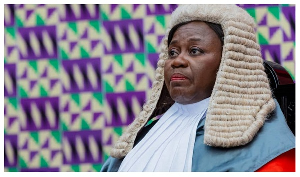 Gertrude Torkornoo was removed as Chief Justice on September 1, 2025