The government has begun piloting a national emergency bed management system aimed at addressing Ghana’s persistent “no-bed syndrome” in hospitals.
The system is expected to give health authorities real-time information on available emergency beds, patients occupying them and how long patients have remained in emergency units.
What is the emergency bed management system?
It is a system designed to help the government monitor and manage emergency bed capacity across participating hospitals.
Rather than relying solely on hospitals to report that they have no available beds, authorities will be able to see the situation at participating facilities in real time.
The Minister of Health, Kwabena Mintah Akandoh, has said that a command centre has been established at the Ridge Hospital to coordinate the system.
He said the system allows him to monitor emergency bed availability from his office.
How it works
The beds participating in the system have been fitted with barcodes, while designated commanders at participating hospitals are responsible for updating information.
The system records information on available beds, as well as patients occupying emergency spaces.
This means health authorities can monitor changes in bed availability as they occur and identify hospitals where emergency capacity is under pressure.
Which hospitals are covered?
The pilot currently covers selected regional and teaching hospitals.
The government is expected to use the pilot to assess how effectively the system can improve the management of emergency beds before a wider rollout.
The emergency bed management system is primarily a management tool. It does not itself create additional beds.
According to Akandoh, its purpose is to ensure that existing beds are used more efficiently and that patients do not remain in emergency units longer than necessary when other capacity is available.
How will it track patients in emergency units?
The system will also monitor how long patients remain in emergency wards.
The Health Minister said this would allow authorities to investigate cases where patients remain in emergency for prolonged periods despite hospitals reporting a shortage of beds.
For instance, if a patient has remained in an emergency unit for more than 24 hours, the command centre would be able to identify the situation and seek an explanation from the facility.
Why is this important?
Ghana's “no-bed syndrome” has been a longstanding challenge, particularly for patients requiring urgent medical attention.
In some cases, patients have faced difficulties securing beds at hospitals, leading to delays in admission or the continued use of emergency spaces.
The new system is intended to provide authorities with better visibility of available capacity and help coordinate patients across facilities.
How does the ambulance service fit into the system?
The ambulance service has also been integrated into the system.
This is intended to help ambulance teams determine which hospitals have available capacity before transporting patients.
The approach could reduce situations where ambulances take patients to facilities that are already overwhelmed or have no appropriate emergency beds available.
What is happening at major hospitals?
The government is also expanding emergency capacity at some major hospitals, including Korle-Bu Teaching Hospital, Komfo Anokye Teaching Hospital, Tamale Teaching Hospital and The 37 Military Hospital in Accra.
At Korle-Bu, the Health Minister said the emergency unit currently has about 67 beds.
He also disclosed that a 400-bed facility is under construction as part of a wider redevelopment project.
The facility is expected to function as a “hospital within a hospital”.
How many ambulances are currently available?
Akandoh said more than 200 government ambulances are currently operational.
He attributed the improvement partly to the government's decision to insure its ambulances in 2025.
o Bed Syndrome in Ghana: Time for health system redesign, not just reform
The government also plans to add 100 new ambulances to the national fleet in 2027.
What is the main goal of the pilot?
The broader objective is to make better use of Ghana's existing emergency capacity.
The system is expected to give authorities a clearer picture of where beds are available, where patients are waiting and where emergency units may be congested.
The government will use the pilot to assess the system before determining how it can be expanded across the country.
JKB/VPO
THE LOWDOWN: GES PRO Speaks on SHS Placement Crisis and Teachers’ Strike
Health News of Thursday, 8 October 2026
Source: www.ghanaweb.com
What to know about Ghana’s pilot emergency bed management system
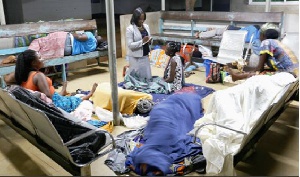 File photo of patients on the floor of a hospital due to unavailability of beds