Ghanaian urban planner and the African Ambassador for Inclusive Urban Governance and Climate-Resilient Development, Gifty Nyarko, has urged the global community to embrace inclusive and African-led approaches in shaping the future of sustainable cities and built environments.
Gifty Nyarko made the call while addressing experts, policymakers and industry leaders committed to advancing innovative solutions for resilient urban development at the 1st Global Scholarship for Sustainable Built Environment Research Conference held at the University of Johannesburg, South Africa.
Speaking before an audience of scholars, urban planners, engineers, architects, policymakers, and development partners, Planner Gifty Nyarko, a strong advocate for a paradigm shift in the way cities are researched, planned and built, urged professionals in the built environment to embrace inclusive, African-led, and community-anchored approaches to urban development.
“The question is not whether Africa is urbanising but whose knowledge is shaping that urban future, and whose voices are being left behind,” she said.
She stressed that while African cities demonstrate innovation and resilience, they remain disproportionately vulnerable to climate change, inequality, and systemic exclusion, but these complex challenges cannot be solved through fragmented disciplines, elite-driven models, or externally imposed frameworks.
“We cannot build inclusive, climate-resilient cities using fragmented and exclusive approaches…True inclusion requires us to dismantle hierarchies in knowledge production and shift from research for communities to research with communities.”
She challenged engineers, architects, and physical planners to lead the shift toward interdisciplinary, participatory, and context-sensitive practices since the future of sustainable cities depends on professionals embracing interdisciplinary collaboration, where expertise from diverse fields converges to design solutions that reflect the complexity of urban life.
“Engineers and architects must move beyond technical solutions and begin to see communities as co-creators, not clients. Your designs and innovations must be grounded in lived experience and community realities, particularly those of informal workers, women, youth, and marginalised groups.”
She emphasised that African communities are not waiting for external validation to innovate, as youth-led design studios, participatory housing upgrades, and community mapping projects are already reshaping urban futures across the continent and called for these approaches to be amplified, scaled, and institutionalised through stronger policy, investment, and professional adoption.
Will Ghana pass the Anti-Witchcraft Bill? Find out in the latest episode of The Lowdown on GhanaWeb TV in this conversation with Amnesty International:
Regional News of Wednesday, 10 September 2025
Source: Aboagye Frank, Contributor
Urban planner calls for African-led vision in building sustainable cities
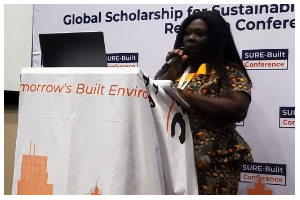 Gifty Nyarko is an urban planner



Entertainment