November 12 remains a significant date in Ghana's political history, marking the death of one of the country's most influential leaders, former President, Jerry John Rawlings, who died on November 12, 2020, at the age of 73.
Rawlings passed away at the Korle Bu Teaching Hospital in Accra after a short illness, bringing to an end a political journey that profoundly shaped Ghana's military and democratic history.
From a young Air Force officer who staged two military uprisings to a democratically elected President who served two terms, Rawlings left behind a legacy defined by political upheaval, revolutionary reforms, economic transformation and an enduring influence on Ghanaian politics.
His death came just weeks before the December 7, 2020, general election, making his passing particularly significant for a country preparing for another major political contest.
From coup leader to Ghana's first Fourth Republic President
Rawlings' rise to power was anything but conventional. Born on June 22, 1947, in Accra, he trained as an officer in the Ghana Air Force before becoming a central figure in the country's political upheavals.
His first major attempt to seize power came on May 15, 1979, when he led a failed military uprising against the government of General Fred Akuffo. He was arrested, court-martialled and sentenced to death.
However, before the sentence could be carried out, a group of junior military officers staged another coup on June 4, 1979, freed him from detention and installed him as chairman of the Armed Forces Revolutionary Council (AFRC).
The AFRC's rule was short-lived. After overseeing what it described as a house-cleaning exercise against corruption and misconduct in public office, Rawlings handed over power to the elected civilian government of Dr Hilla Limann in September 1979.
The return to civilian rule did not end his involvement in Ghanaian politics. On December 31, 1981, Rawlings led another military coup, overthrowing Limann's government and establishing the Provisional National Defence Council (PNDC), with himself as chairman and head of state.
He remained in power until January 1993, when Ghana transitioned to constitutional multiparty democracy under the 1992 Constitution.
Rawlings subsequently retired from the military, contested the December 1992 presidential election on the ticket of the National Democratic Congress (NDC), and became the first President of Ghana's Fourth Republic.
He won a second four-year term in the 1996 elections, serving until January 7, 2001, when he handed over power to New Patriotic Party (NPP) candidate John Agyekum Kufuor following the NDC's defeat in the 2000 elections.
A legacy that continues to divide opinion
Rawlings' political career remains one of the most debated chapters in Ghana's history.
To his supporters, he was a fearless leader who challenged corruption, championed ordinary citizens and promoted discipline in public life. His political philosophy, often associated with accountability and social justice, became a defining part of the NDC's identity.
His administration also oversaw major economic policy changes, particularly the Economic Recovery Programme introduced in 1983 with support from the International Monetary Fund (IMF) and the World Bank.
The programme sought to reverse years of economic decline through reforms in public finance, trade, agriculture and state institutions. Although the reforms helped restore economic growth and international confidence, they also attracted criticism over their social costs and the hardships experienced by sections of the population.
However, Rawlings' legacy was not without controversy. His military governments were criticised over human rights abuses, political repression and the use of revolutionary tribunals. The 1982 abduction and murder of three High Court judges and a retired army officer remains among the darkest episodes associated with the early PNDC era.
Consequently, his place in Ghana's history is often viewed through two contrasting lenses: the revolutionary military officer who promised to fight corruption and the political leader whose years in power were marked by both significant reforms and serious human rights concerns.
His death brought Ghana's 2020 election campaigns to a halt
When news of Rawlings' death broke on November 12, 2020, Ghana was just weeks away from the December 7 general election. His passing immediately changed the political atmosphere, with leading political figures suspending their campaigns to mourn the former President.
Then-President Nana Addo Dankwa Akufo-Addo announced seven days of national mourning, from November 13 to November 20, 2020, and directed that national flags be flown at half-mast across the country.
Akufo-Addo, who also suspended his campaign alongside Vice President Dr Mahamudu Bawumia, described Rawlings' death in a statement as the fall of a great tree, declaring: "Ghana is poorer for this loss."
The NDC's presidential candidate at the time, former President John Dramani Mahama, also suspended his campaign tour of the Ashanti Region and other party activities following the news.
The decision to suspend campaign activities across the political divide reflected the significance of Rawlings' contribution to Ghana's political development, despite the sharp disagreements that characterised his years in power.
Six years after his death, Rawlings remains a towering and controversial figure in Ghana's political history. His journey from a young military officer facing a death sentence to a two-term democratically elected President captures an extraordinary chapter in the country's transition from military rule to constitutional democracy.
For many Ghanaians, his name remains synonymous with the June 4 revolution, the NDC's founding and the political changes that shaped the Fourth Republic.
His death on November 12, 2020, closed a remarkable chapter in Ghana's history, but the debates surrounding his leadership, achievements and controversies continue.
EA
General News of Thursday, 12 November 2026
Source: www.ghanaweb.com
Today in History: Jerry John Rawlings dies at 73
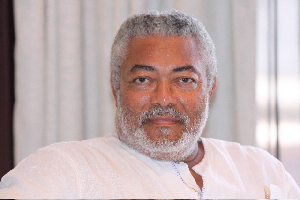 A photo of the late President Jerry John Rawlings