President John Dramani Mahama sacked Chief Justice Gertrude Torkornoo on Monday, September 1, 2025, hours after he received the report of the 5-member committee he set up, in accordance with the 1992 Constitution of Ghana, to probe three petitions he received for her removal.
The government, through the Minister of Government Communications, Felix Kwakye Ofosu, has stated that although Justice Torkornoo has been informed of the reasons for her removal, Article 146 of the constitution prohibits public disclosure of the committee's proceedings.
Nevertheless, Justice Torkornoo, while in office, took some unpopular decisions, which many believe were her undoing and eventually led to her losing her job.
Some of these actions of the former Chief Justice were cited in the report of one of the three petitions – the petition of Daniel Ofori, which was submitted to President Mahama.
Chief Justice Gertrude Torkornoo sacked
The actions led to wild criticisms of Gertrude Torkornoo, with a section of the public accusing her of interfering in cases, such as reconstituting the panel of judges presiding over some court cases, which constitutes stated misbehaviour and warrants removal.
She was also accused of financial misappropriation, questionable judgment, and questionable administrative decisions.
Below are some of the ‘sins’ of the sacked Chief Justice, Gertrude Araba Torkornoo, which some people believe warranted her removal:
Financial misconduct
One of the main grounds for the removal of the Chief Justice in Daniel Ofori’s petition was alleged financial misappropriation against her.
Justice Torkornoo was accused of making illegal payments to her two immediate family members — her husband, Francis Kofi Torkornoo, and their daughter, Sarah Edem Amiga Torkornoo — for a trip.
The sacked Chief Justice reportedly spent nearly GH¢260,000 on business class air tickets and approximately $30,000 in per diem allowances for her family during the trip.
An audit report on the Judicial Service found that “both the Chief Justice and her predecessor, Justice Anin Yeboah, misused public funds to sponsor luxury family trips, sidelining official security arrangements.”
It was alleged that Justice Torkornoo took her husband on a trip to Tanzania, incurring flight costs exceeding GH¢75,000, and received US$14,000 in accountable imprest for the trip, which she has yet to refund.
In another trip to the United States, Justice Torkornoo’s daughter allegedly had her ticket upgraded, with a total cost of GH¢109,482.00 for the trip and a per diem of US$10,000.
25 Witnesses, 8 Lawyers, 1,000 Pages: Inside the report behind CJ Torkornoo's removal
Questionable judgment
One of the accusations against the former Chief Justice, captured in most of the petitions, was the issuance of questionable judgments in cases she presided over.
The petition submitted by Shining Stars accused her of breaching the 1992 Constitution of Ghana in her ruling in the suit filed by the current Minority Leader, Alexander Kwamina Afenyo-Markin, against the Speaker of Parliament, Alban Bagbin, over the declaration of four seats in Parliament as vacant.
The group argued that the decision of the court to overturn the judgment of the Speaker of Parliament did not follow due process and pointed to incompetence, which is grounds for removal.
“We are of the view that the Speaker’s decision does not meet the threshold of irreparable harm upon which the court grants orders of stay of execution without hearing him. We hold on to that view because those Members of Parliament who might have been affected by the Speaker’s ruling could seek legal redress and reverse whatever privileges and rights were denied them.
“We further express our opinion on the ruling of the Speaker’s application that the Chief Justice who presided over the above application breached the rules of natural justice, which has been raised to a constitutional right in Article 23 of the 1992 Constitution of Ghana. However, such a major breach by the Chief Justice, in our opinion, amounts to incompetence,” part of the petition is said.
A report by theheraldghana.com also indicated that another claim of questionable judgment against the Chief Justice was the case filed by one Daniel Ofori against Ecobank Ghana Limited.
The Supreme Court panel that presided over the case allegedly felt that although the complainant had merit, ruling in their favour would collapse the financial institution.
Questionable administrative decisions
According to asaaseradio.com, the petition by Ayamga Akolgo accused Gertrude Torkornoo of violating the ethics of the bench and called for her removal. The senior police officer is reported to have stated in his petition that the Chief Justice abused her powers by wrongly causing his arrest and detention.
“She abuses the sacred judicial office by wrongly causing my arrest and detention. The arrest and detention were capricious, unreasonable, unilateral, and without justification, constituting stated misbehaviour and incompetence as provided in Article 146(1) of the Constitution. The arrest and detention infringed on my rights, dignity, and resulted in pain, trauma, and humiliation.
“She failed or neglected to perform her judicial duty of recording the occurrence in the court’s record book. She authorised, supervised, and approved false statements or false entries in the search report.
“The supervision of false statements in the search was intended to deceive, cover up, obstruct, or pervert the course of justice, or constitute criminal fabrication of evidence, contrary to statutes, the Code of Conduct for Judges, and consistent with stated misbehaviour and incompetence as provided in Article 146(1) of the Constitution,” parts of Ayamga Akolgo’s petition are quoted by the media house.
Transfer of judge in the Opuni trial
The trial of former COCOBOD CEO, Dr Stephen Opuni (The Republic v. Stephen Kwabena Opuni, Seidu Agongo, Agricult Ghana Ltd), has also been cited as a clear example of the Chief Justice abusing her administrative powers. She was accused of reconstituting a Supreme Court panel sitting on the matter when the case was going against the then Nana Addo Dankwa Akufo-Addo government.
Justice Honyenuga, who originally presided over the trial, retired. The case was then reassigned to Justice Kwasi Anokye Gyimah, who ruled on April 4, 2023, that the trial should start afresh (de novo), taking into account witness demeanour and fairness concerns raised by the defence. This approach is standard in criminal trials.
However, the Attorney General at the time, Godfred Dame, appealed this ruling. On July 3, 2023, the Court of Appeal ruled that the High Court should adopt the previous proceedings, calling the decision to restart the case a misdirection.
Subsequently, the Chief Justice transferred Justice Anokye Gyimah to Kumasi and appointed Justice Aboagye Tandoh from Winneba to take over. No explanation was given for this transfer, sparking public suspicions that it was politically-motivated.
Reconstitution of panel in Dr Opuni’s appeal
Dr Opuni’s legal team, led by lawyer Samuel Codjoe, filed an interlocutory appeal at the Supreme Court on July 7, 2023, challenging the Court of Appeal’s decision. A hearing began on January 17, 2024, with a five-member panel.
However, on May 8, 2024, the Chief Justice controversially reconstituted the panel, retaining only two of the original members, and presiding over the new panel herself.
Codjoe objected, citing Article 157(3) of the constitution, which prohibits a judge or panel from withdrawing after hearing arguments.
Despite the objection, the reconstituted panel dismissed the appeal on June 19, 2024, upholding the Court of Appeal’s ruling.
Critics argued that the Chief Justice had no administrative authority to reconstitute the panel without justification, suggesting a usurpation of judicial power.
The Ablakwa case
On June 25, 2024, lawyers for the MP for North Tongu objected to a reconstituted Court of Appeal panel. They noted that the original panel — Justices Senyo Dzamefe (Presiding), Alia Serwaa Asare-Botwe, and Archer — had been replaced by Justices Pamela Koranteng (Presiding) and Kweku Ackaah Boafo, with only Asare-Botwe remaining.
The objection was dismissed, but later evidence revealed that Justice Dzamefe had been directed to return the docket to the Chief Justice.
Republic vs Elisha Mahama & two others
On May 22, 2024, during proceedings in the Wa High Court, it was announced that the Chief Justice had directed that, following the committal proceedings in Wa, all further proceedings be transferred to Kumasi.
This decision drew widespread criticisms from the Upper West Region, given that the crime took place in Wa, and most witnesses and the prosecution resided there. Although the Chief Justice eventually reversed the decision, the original directive was seen as arbitrary and unreasonable.
Vacant seat case
The former Chief Justice also came under fire for her handling of a case filed by the MP for Effutu, challenging the declaration of four vacant parliamentary seats by Speaker of Parliament, Alban Bagbin.
Critics questioned the speed with which the case was heard and accused her of prioritising a case aligned with the then-ruling New Patriotic Party (NPP).
She was also criticised for declaring that Ghana was in a constitutional crisis due to Parliament not sitting.
Speaker Bagbin refuted this, stating: “There is no constitutional crisis.” He explained that Parliament had been adjourned sine die to allow leadership to resolve the impasse surrounding the seats.
BAI/AE
GhanaWeb's latest documentary, Sex for Fish, that explores the plights of teenage girls in coastal communities, all in an attempt to survive, is out. Watch it below:
General News of Tuesday, 2 September 2025
Source: www.ghanaweb.com
The 'sins' of sacked Chief Justice Torkornoo
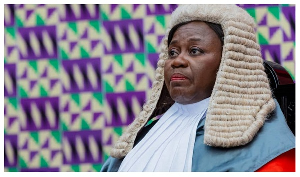 Justice Gertrude Torkornoo has been removed as Chief Justice