A one-day seminar focused on competition economics, policy, and law has taken place in Accra.
The seminar was attended by legal and consumer representatives from public and private organisations across various industries, as well some members of the judiciary.
It was organised by the Competition and Markets Centre, with competition law experts from King’s College, delivering the lecture.
Opening the seminar, Benson Nutsukpui, Managing Partner of Kuenyehia & Nutsukpui, and a former President of the Ghana Bar Association, underscored the urgent need for a comprehensive and coherent competition law framework in Ghana.
He described the current regulatory regime as fragmented, relying on scattered statutes and sector-specific mandates, which are inadequate for addressing complex market dynamics such as cartels, abuse of dominance, and merger control.
Drawing from practical experience, he cited the prolonged litigation between Internet Ghana Limited and Ghana Telecom as evidence of the inefficiencies created by the absence of a dedicated competition authority, noting that such disputes could have been resolved more effectively within a structured regime.
“What we do not have is a coherent, economy-wide competition statute that addresses cartels, abuse of dominance, and merger control in a systematic way.
"The result is a framework that is woefully inadequate to the demands of a modern market economy,” he stated, emphasising that Ghana is at a pivotal policy juncture, with a draft Competition Policy and Bill still to be enacted, providing stakeholders with a crucial opportunity to develop a strong and future-proof framework.
Highlighting the importance of clarity in legal drafting, he warned against poorly calibrated provisions, stating that, “a competition regime that departs from settled principles… can produce regulatory outcomes that harm the very markets it seeks to protect.”
He also noted regional developments, including the AfCFTA Protocol on Competition Policy, as emphasising the need for alignment to avoid putting Ghanaian businesses at a disadvantage.
Mr. Nutsukpui described the seminar as a timely platform for collaborative engagement among legal, economic, and regulatory actors, expressing confidence that such dialogue will translate into actionable reforms.
As he notes, “some conversations are too important to delay,” reinforcing the urgency and significance of advancing Ghana’s competition policy agenda.
The keynote speaker for the one-day seminar, Dr. Juliette Twumasi-Anokye, who chairs the ECOWAS Regional Competition Authority’s decision-making Council, framed the debate within Ghana’s regional and continental commitments.
She noted that the ECOWAS Treaty and the African Continental Free Trade Area (AfCFTA) Protocol on Competition Policy made coherent domestic enforcement not just desirable, but essential.
“Competition law is at its core protecting the process of competition, not competitors. It must ensure markets remain open, dynamic, and innovative. For us in Ghana, this is not merely a legal, economic or even a political issue; it is a crucial developmental imperative,” Dr. Twumasi-Anokye stated.

She highlighted the risks of fragmented oversight, digital market complexities, and the need for institutional capacity, adding: “Effective competition enforcement requires more than legislation, it requires skilled professionals, economic expertise, judicial understanding, and strong investigative tools.Investment in capacity building must remain of the utmost priority.”
Peter Alexiadis, Visiting Professor at King’s College London and former Partner-in-Charge of Gibson, Dunn & Crutcher’s Brussels office, addressed the technical gaps in the draft Bill, particularly the treatment of intellectual property rights and the definition of market power.
He emphasised that a competition regime that departs from internationally accepted methodologies risked producing outcomes that harmed the very markets it sought to protect.
David Bailey KC, Professor of Practice Law at King’s College London and Standing Counsel to the UK Competition and Markets Authority, underscored the importance of aligning Ghana’s framework with evolving global practice, particularly in digital markets.
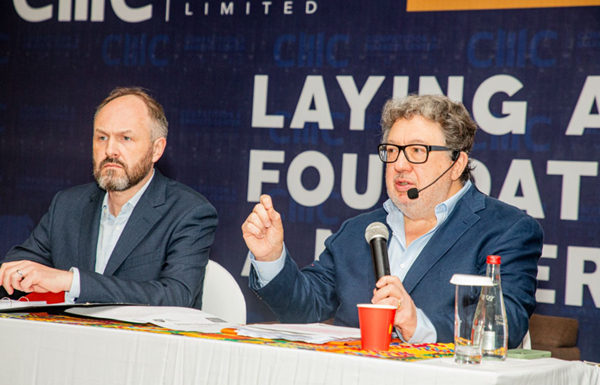
He called for a regime that balances rigorous enforcement with predictability for businesses, noting that well-designed competition law serves as an enabler of innovation rather than a constraint.
The Managing Director of the Competition & Markets Center, Mr. Kofi Datsa, reaffirmed the seminar’s purpose as a final window for constructive input before the Bill is laid before Parliament. “Once a bill passes, the architecture is fixed.
Today, it is still open. This seminar is designed not merely to educate, but to galvanise stakeholders—lawmakers, regulators, the judiciary, and the business community—to engage with the drafts and ensure that Ghana’s competition law is built on sound principles from the outset.
We are grateful to our distinguished speakers and all participants for committing to this critical national conversation,” Mr Datsa said.

Participants at the seminar included representatives of the Ministry of Communications, Digitalisation and Innovation, sectoral regulators such as the Public Utility Regulatory Authority (PURC), National Communications Authority (NCA), National Insurance Commission (NIC).
Also in attendance were representatives from the Chamber of Telecommunications, GRIDCO, MTN, AT, C-Squared, CUTS International, and lawyers from firms such as BELA, AB & David, Law Trust, N. Dowouna and Co, Amenuvor and Associates, among others.
General News of Sunday, 29 March 2026
Source: www.ghanaweb.com
Seminar on Competition Policy and Law held in Accra
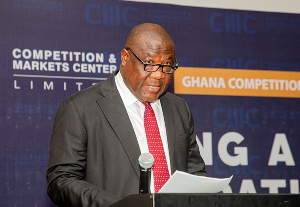 Managing Partner of Kuenyehia & Nutsukpui, past President of Ghana Bar Association, Benson Nutsukpui







Opinions