The Managing Director of the International Monetary Fund (IMF), Kristalina Georgieva, has warned that recent attacks on Saudi Arabia could have negative consequences for economies and people worldwide, as tensions in the Middle East drive up energy costs.
The warning raises fresh concerns for Ghana, which is already reeling from the effects of the ongoing conflict in the region, particularly through energy price shocks that threaten to increase the cost of fuel and put further pressure on households and businesses.
Speaking at a press briefing on Wednesday, October 14, 2026, during the IMF and World Bank Annual Meetings in Bangkok, Thailand, Georgieva said developments in Saudi Arabia could have far-reaching consequences because of the country's importance to the regional and global economy.
“The Saudi economy is important for the region and the world, and in that sense, these developments have potentially negative spillovers for everybody, everywhere,” she said.
For Ghana, further increases in global energy prices could add to existing economic pressures. As a country that depends on imported petroleum products, Ghana is vulnerable to disruptions in global oil supplies and price increases triggered by geopolitical tensions.
Higher international crude oil prices can translate into more expensive fuel at the pump, raising transportation and distribution costs and potentially feeding into the prices of goods and services.
Businesses that rely on fuel for transport, production and power generation could also face higher operating costs, while households may have to spend more on transport and other essentials.
The impact will depend on how the conflict develops, the direction of global oil prices and how these changes feed through to Ghana's domestic fuel market.
The IMF has previously warned that countries that import energy and have limited room to cushion economic shocks face a heavier burden when global energy prices rise. In its assessment of Ghana, the Fund also identified the country's dependence on imported fuels as a source of vulnerability to global conflicts and commodity-price fluctuations.
Story by Mawuli Ahorlumegah, reporting from the 2026 IMF/World Bank Annual Meetings in Thailand, Bangkok
Business News of Wednesday, 14 October 2026
Source: www.ghanaweb.com
Saudi attacks could drive up global energy costs - IMF Managing Director
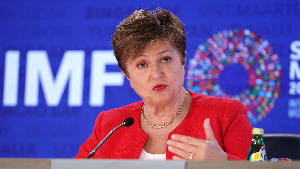 IMF Managing Director, Kristalina Georgieva



Entertainment