The Northern Regional Command of the Ghana National Fire Service (GNFS) says it recorded a total of 67,200 prank emergency calls in 2025.
Mr Hudu Baba, the Northern Regional Public Relations Officer of the GNFS, said the prank calls included about 1,400 of those received within a single week, with other instances where it recorded more than 100 prank calls in a day.
He explained that such calls diverted fire tenders, personnel, and logistics from genuine emergencies, delaying response time to real fire outbreaks, and other rescue operations.
Mr Baba disclosed this in a press statement issued in Tamale and sighted by the Ghana News Agency, which provided a comprehensive account of fire and rescue incidents recorded in the Northern Region for the year 2025.
The statement said the region recorded a total of 377 fire incidents from the 1st of January to December 31, 2025, compared to 373 fires over the same period in 2024, representing a marginal increase of four cases, or about one per cent.
The statement said the estimated cost of damage to properties as a result of the fires in the year under review stood at GHS159,081,662, a significant increase from GHS68,217,224 recorded in 2024.
It said despite the rise in fire incidences and damage cost, the GNFS managed to salvage properties valued at about GHS150,629,102,789 during the year, compared to GHS1,024,438,464 in 2024.
The statement noted that, on average, the Northern Region recorded one fire outbreak per day in 2025.
It said domestic fires accounted for the highest number of incidents with 148 cases, followed by commercial and electrical fires with 54 cases each, while bushfires accounted for 14 cases.
The statement indicated that other fire incidences recorded included vehicular fires and institutional fires with 17 cases each; two cases of industrial fires, and 19 cases categorised as other fires.
It added that January and December were identified as the peak months, recording 65 and 52 fires respectively, representing 17.2 per cent and 13.8 per cent of the total number of fires recorded in the year.
The statement emphasised that the GNFSS recorded 145 “out-before-arrival” cases in 2025, compared to 143 cases in 2024.
It explained that the high number of out-before-arrival cases was an indication that public education and sensitisation programmes were yielding positive results, as many community members were now able to control minor fire outbreaks before the arrival of fire personnel.
The statement also highlighted a worrying trend involving fires in uncompleted buildings, particularly in newly developed settlements across the region.
It said a total of 17 fire cases involving uncompleted buildings were recorded in 2025, representing 4.5 per cent of all cases recorded during the year.
The causes of fires were largely attributed to electrical faults, including circuit overloads, short circuits, inferior electrical cables, poor wiring systems, ageing wires, and earthing challenges, the statement said.
Other identified causes included gas leakages, unattended to cooking, unattended lit candles, mosquito coils, cigarette butts, bush burning, poorly executed welding works, children playing with fire and deliberate acts, it said.
In terms of casualties, the statement said the GNFS recorded two fire-related deaths in 2025.
However, no deaths were recorded from flooding, drowning, bee invasion, or height-related rescue cases during the year.
On road traffic collisions, the statement said the Command recorded four cases in 2025, resulting in one injury and two fatalities, compared to five incidences in 2024 which resulted in 20 injuries and four deaths, indicating a reduction in casualties.
The statement attributed the slight increase in fire cases to harsh harmattan weather conditions experienced during the first and last three months of 2025, as well as non-compliance with basic fire safety measures, especially in domestic settings.
The statement therefore appealed to members of the public to change their attitudes towards the use of naked flames, gas appliances, and electrical equipment to prevent avoidable fires.
It further cautioned against pranking the GNFS on its emergency numbers 191 and 112, and the regional direct lines, to allow fire officers to respond promptly to genuine emergencies.
The statement reaffirmed the commitment of the GNFS towards reducing fire incidents through intensified public safety education and sensitisation, announcing that the Service would roll out a new campaign dubbed “1 Fire Officer, 1 School,” under which each fire officer would adopt a school to educate pupils and staff on fire safety and prevention by the end of the first quarter of the year.
It expressed confidence that with sustained public support, the GNFS would achieve a further reduction in fire outbreaks across the Northern Region.
Regional News of Tuesday, 13 January 2026
Source: GNA
Northern Region: GNFS records 67,200 prank calls in 2025
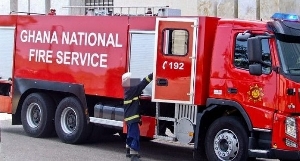 Ghana National Fire Service vehicle