President John Dramani Mahama on Wednesday engaged the leadership of businesses and captains of industry at the Presidency in Accra to discuss the government’s new “24-Hour Economy Policy.”
The “24-Hour Economy Policy” aims to stimulate economic activity by encouraging businesses to operate around the clock, or at least in multiple shifts, to increase productivity and create jobs.
The President’s multi-sectoral engagement on the implementation of the “24-Hour Economy Policy,” a crucial part of the government’s national reset agenda, was attended by over 200 participants.
President Mahama said the 24-Hour vision was both a destination and a programme.
He explained that as a destination, the 24-Hour Economy Policy reflected a state where Ghana’s productivity and capital utilization would become so high that businesses would need to operate in multiple shifts across day and night, maximizing returns on infrastructure, human resources, and innovation.
This idea, he said, captured the public imagination during the 2024 campaign and remains at the core of their drive toward full employment and inclusive economic growth.
He added that as a programme, the 24-Hour Economy demanded a deep and deliberate restructuring of the productive economy.
“We must re-engineer our production systems from top to bottom, boosting volumes and diversity, and shifting from reliance on raw materials toward the export of value-added products, wholesome foods, pharmaceuticals, garments, industrial inputs, and digital services,” President Mahama said.
He revealed that earlier this month, he received a complete draft of the 24-Hour Economy Policy from his advisor, Mr. Goosie Tanoh.
President Mahama said he had reviewed the report and was confident there was now a coherent and actionable framework to deliver results.
President Mahama noted that an effective catalyst for the 24-Hour Economy Policy was a stable macroeconomic environment, which they were achieving through close coordination between the monetary and fiscal authorities; however, the programme went beyond macroeconomic stability.
This, he said, was being pursued by the Ministry of Finance and the Bank of Ghana, and it focused sharply on production, enterprise, jobs, and exports.
He emphasized that at its core, it was an integrated value chain transformation approach, which addressed structural bottlenecks not in isolation but comprehensively through infrastructure, finance, land systems, logistics, and skills development.
He highlighted that one of its boldest proposals was the development of the Volta Lake Economic Corridor.
He explained that the corridor, centered on the Volta Lake and the Volta Basin, would become a national production zone and logistics hub.
He noted that the 24-Hour Economy Policy document would be made public on Tuesday, June 3.
He added that the 24-Hour Economy Secretariat would be decentralized to the district level to enable all districts to benefit from it.
The President said the government would officially launch the 24-Hour Plus Programme on July 1, Ghana’s Republic Day.
Business News of Thursday, 29 May 2025
Source: GNA
President Mahama engages businesses on government’s 24-Hour Economy Policy
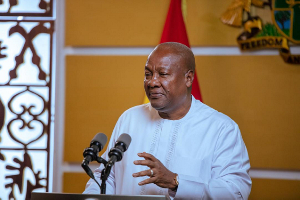 President John Dramani Mahama


Business