The National Premix Fuel Secretariat has renewed calls for full accountability of premix funds managed between 2017 and 2024, as fresh figures from the Sekondi Landing Beach Committee highlight the benefits of transparent management under the current system.
The landing beach committees of New Takoradi in the Takoradi Metropolis also raised GH¢59,000 for community development, while Abuesi in the Shama District realised GH¢102,000.
Administrator of the Secretariat, Ebow Mensah, stressed that premix fuel proceeds are a state subsidy governed by L.I. 2233, which clearly allocates more than half of the margins to fishing communities for development purposes.
“These are not discretionary funds,” he said. “They belong to the community, and communities have the right to know how much accrued to them and what it was used for.”
Mensah noted that the lack of proper accounting for the 2017-2024 period has fuelled disputes at several landing beaches, with fisherfolk often unsure whether projects attributed to premix funds were genuinely financed from their community share.
According to him, addressing this historical gap is critical to restoring confidence in the premix system.
“You cannot build trust by ignoring the past,” he said. “If people do not understand what happened to earlier funds, it becomes difficult to convince them that the system is now working in their interest.”
The Secretariat says it will work closely with metropolitan and municipal chief executives, who are mandated by law to oversee landing beach committees, to retrieve, review and present past records to communities where possible. Chief fishermen, who chair most landing beach committees, are also expected to play a central role.
“Fortunately, chief fishermen are relatively stable in their positions,” Mensah said. “We intend to empower them to insist on accountability and ensure that premix funds serve the purpose for which they were created.”
He added that the current accountability series, which has so far covered only three communities, is being used to test a framework that will later be rolled out nationwide.
“Come early 2026, this will be done across the country,” he said. “All committees will be expected to render accounts, discuss the community development funds, and confirm that the monies have been lodged in accounts established by law.”
The renewed push for accountability comes as the Sekondi Landing Beach Committee disclosed that it had raised GH¢126,000 for community development within ten months.
The figures were presented during the Premix Accountability Series in the Western Region, where committees from Sekondi, New Takoradi and Abuesi publicly accounted for their premix fuel allocations and proceeds for the 2025 operational year.
Mensah said the disclosure demonstrates what is achievable when premix margins are properly tracked and managed in line with the law.
“The committees indicated the consignments they received, the sales they made, and the amounts that accrued to the community development fund. This is exactly how the system is supposed to work,” he said.
Under L.I. 2233, 53 per cent of premix fuel margins must be reserved for community development and paid into a designated bank account controlled through agreed signatory arrangements.
Mensah explained that the funds are meant to support projects that benefit entire fishing communities, including sanitation, safety infrastructure and livelihood-related initiatives.
“These are funds that belong to the community,” he said. “When communities can see the figures and verify the bank balances, trust improves and conflict reduces.”
He added that the Secretariat will encourage quarterly public accounting at landing beaches to allow fisherfolk, through consultation, to decide how their community development funds should be used.
Mensah warned that failing to confront the accountability gap from 2017 to 2024 could undermine the future of the premix system.
“If we do not account for the past, the future of the premix system remains at risk,” he said.
Regional News of Wednesday, 17 December 2025
Source: www.ghanaweb.com
Premix Secretariat: Sekondi Committee raises GH¢126,000 in accountability exercise
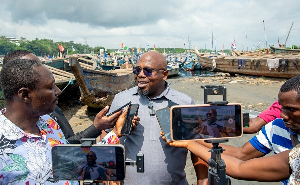 Administrator of the Secretariat, Ebow Mensah