The Deputy Crime Officer for the Ashanti South Police Command (Bekwai), ASP Peasah Darkwa, has emphasized that police restrictions on certain areas, such as crime scenes, are not intended to hinder journalists, but to ensure their safety and preserve evidence for investigations.
He warned that individuals who trespass in areas barricaded by the police risk implicating themselves and could face serious consequences.
"When a crime happens, the police conduct investigations with the available evidence. However, we cannot allow just anyone to enter the crime scene since we need to preserve the evidence. If journalists enter restricted areas, they might destroy what we are looking for or even put themselves in danger," ASP Darkwa explained.
He further noted that items such as footprints and other physical evidence are crucial for police investigations, and unauthorised access to crime scenes could compromise investigations.
"Persons who trespass on crime scenes are likely to implicate themselves, thus ending up in trouble," he added.
ASP Darkwa made the remarks during a media-security dialogue in Kumasi on collaboration between the police and journalists. The capacity-building workshop, organized by the Media Foundation for West Africa (MFWA), was themed “Strengthening Collaboration Between the Media and Security Agencies in Ghana.”
The program aimed to bridge the gap between security officers and journalists, particularly regarding access to crime scenes and preservation of evidence.
Speaking as a participant, ASP Darkwa said the workshop provided a vital platform for both parties to understand their respective mandates.
He emphasised that while the media’s role is to inform the public, the priority of security agencies is to ensure the integrity of investigations.
He called for a new era of cooperation and mutual respect between law enforcement agencies and the media to prevent misunderstandings during the discharge of duties.
"The media must understand the nature of our work, just as we must understand theirs. If a security incident occurs and the media arrives, there should be no misunderstanding because we are both essentially working toward the same goal: serving the public," he said.
"I believe that from today onward, there will be no more misunderstandings. When we have programs like this regularly, it helps us prevent conflict. All of us must understand why certain protocols are in place at crime scenes," he observed.
ASP Darkwa praised the Media Foundation for West Africa for the initiative and suggested that such programs be held regularly to sustain improved relations and prevent friction between the two institutions.
The workshop brought together selected journalists and key personnel from the Ghana Police Service, Ghana Immigration Service, Ghana National Fire Service, and Ghana Prisons Service.
At the conclusion, both parties pledged to respect each other’s roles, prioritise professionalism, and foster collaboration to ensure smooth and peaceful nation-building.
Regional News of Monday, 23 February 2026
Source: Nana Peprah, Contributor
Police urge journalists to respect crime scene protocols
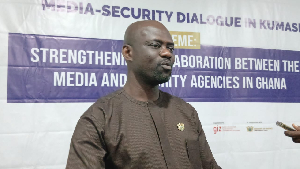 ASP Peasah Darkwa is the deputy crime officer for the Ashanti South Police Command