Forty-four years ago, on November 23, 1982, Ghana was thrown into another military crisis after soldiers attempted to overthrow the government of then-military leader Jerry John Rawlings, triggering gunfire at Burma Camp in Accra.
The attempted coup, which began at Gondar Barracks within Burma Camp, was eventually suppressed by troops loyal to the Provisional National Defence Council (PNDC) government.
The incident became one of the earliest major challenges to Rawlings' second coming to power following the December 31, 1981, coup that toppled the democratically elected government of President Hilla Limann.
Rawlings had established the PNDC to govern the country after taking power, but tensions were already emerging within the military and among some supporters of the revolutionary administration.
Retired GBC staff recounts 1983 gun battle in a failed attempt to overthrow Rawlings
The situation escalated on November 23, 1982, when dissident soldiers took control of part of Gondar Barracks. Gunfire was also reported around Nima and the Broadcasting House, while mortar fire was directed towards the Castle from the Accra Race Course area.
According to historical accounts, the fighting lasted several hours before government forces regained control.
What triggered the attempted coup?
The attempted overthrow came amid growing disagreements within the PNDC administration.
A day before the shooting, on November 22, 1982, Brigadier General Joseph Nunoo-Mensah, then Chief of Defence Staff and a member of the PNDC, resigned from his positions.
His resignation reportedly followed disagreements over the government's handling of the killings of three High Court judges and a retired army officer in June 1982.
There were also tensions involving sections of the military and revolutionary groups that had initially supported Rawlings' return to power.
One of the prominent figures arrested in connection with the November 23 uprising was Sergeant Daniel Alolga Akata-Pore, a member of the PNDC.
Akata-Pore's alleged involvement in the attempted coup later became a subject of controversy, with accounts differing over his actual role in the events.
Rawlings imposes curfew
Following the failed uprising, Rawlings imposed a dusk-to-dawn curfew across the country and ordered the rebels to surrender.
In a broadcast on Accra radio on November 24, 1982, he warned that the remaining rebels would be dealt with if they failed to surrender.
More than 20 people were arrested in connection with the attempted coup. The government also announced that two people involved in the uprising had been killed while trying to escape.
The incident subsequently led to a series of prosecutions before a Public Tribunal in March 1983.
Ten people appeared before the tribunal, while 12 others were tried in absentia. The proceedings ended in August 1983, with 16 people convicted, including 15 who were tried in their absence. Economist Kwame Pianim was the only person tried in person who was convicted. He received an 18-year prison sentence. Amnesty International later questioned the strength of the evidence used against him.
A turbulent period in Ghana's history
The November 23 uprising was not the last attempt to overthrow Rawlings' government.
Another attempted coup was reported on February 27, 1983, when security forces arrested soldiers and civilians suspected of plotting against the PNDC administration.
Despite the repeated threats, Rawlings remained in power, first as a military leader under the PNDC and later as an elected president under the Fourth Republic.
He eventually handed over power on January 7, 2001, after serving two constitutional terms as president.
The November 23, 1982, uprising remains a significant episode in Ghana's political history, highlighting the internal divisions and military tensions that confronted the PNDC government during its early years.
NA/VPO
General News of Monday, 23 November 2026
Source: www.ghanaweb.com
November 23, 1982: Inside the failed military attempt to overthrow Rawlings
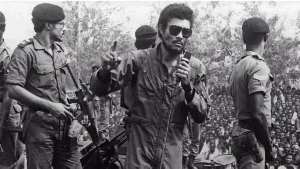 Photo of Jerry John Rawlings during the PNDC erra