Correspondence from Northern Region
The German Ambassador to Ghana, Frederik Landshoft, has advocated for a change in approach toward building the future of Northern Ghana, stating that mere development projects alone cannot transform the area.
Instead, he believes that the future of the north can only be built by young entrepreneurs, risk-taking farmers, and innovators who turn ideas into tangible products.
Mr Landshoft noted that Northern Ghana can achieve sustainable development if young people choose to build their future in the region. He added that creating the enabling conditions for their success must be the collective responsibility of all development stakeholders.
“The future of northern Ghana will not be built by projects. It will be built by entrepreneurs, by farmers who decide to take a risk, by business owners who invest, by innovators who turn ideas into products, by young people who choose to build their futures here, to create the conditions in which they can succeed in our shared task,” the German Ambassador said.
The Ambassador was speaking at the official launch of the Private Sector and Innovation Promotion Project (PSInno) in Tamale on Tuesday.
The project, implemented by the German Agency for International Cooperation (GIZ) in partnership with Ghana’s Ministry of Trade, Agribusiness and Industry, seeks to promote innovation, entrepreneurship, job creation, and the growth of Micro, Small, and Medium Enterprises (MSMEs), particularly in agribusiness and the digital economy. It also focuses on creating sustainable opportunities for youth and women.
According to the German Ambassador, the PSInno signals that Germany's commitment to Northern Ghana is deepening. He stressed that the project adds to the European country’s long-standing support for the area in sectors such as agriculture, education, and economic development.
“Germany has supported the establishment of the Savannah Agricultural Research Institute. We have worked alongside regional institutions to strengthen governance and accountability. We have invested in communities, education, peace building and economic development, and PS-Inno builds on that foundation. It does not start from scratch. It starts from decades of experience, trusted partnerships and a shared understanding of what works. But PS Inno also signals something important. Germany's commitment to northern Ghana is not standing still. We are not only continuing our engagement; we are deepening it,” Mr Landshoft stressed.
The Director of MSME Development at the Ministry of Trade, Agribusiness and Industry, Cynthia Djakoto, emphasised the significant contribution of MSMEs to Ghana’s economic growth.
She noted that the PSInno Project would enhance entrepreneurs' capacity, improve business competitiveness, and create sustainable employment opportunities, particularly for youth and women.
She further encouraged business owners and aspiring entrepreneurs in the region to take full advantage of the programme's training, mentorship, and networking opportunities.
In a speech read on his behalf, the Northern Regional Minister, Ali Adolf John, underscored the importance of the project in promoting economic growth and improving livelihoods in Northern Ghana.
He assured participants of the Regional Coordinating Council’s (RCC) unwavering commitment to supporting initiatives that empower young people and strengthen local businesses.
Regional News of Wednesday, 3 June 2026
Source: www.ghanaweb.com
Northern Ghana's transformation depends on youth innovation – German Ambassador
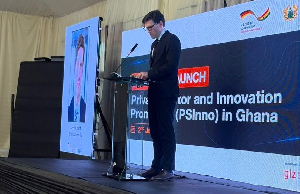 H.E Frederik Landshoft, German Ambassador to Ghana