Traditional leadership is being mobilised as a frontline force in Ghana’s fight against child marriage, with the Obaapa Development Foundation using palace diplomacy, capacity building and public declarations to drive change—one paramountcy at a time.
The Obaapa Development Foundation (ODF) has deepened its national campaign against child marriage with a high-level palace meeting at the New Juaben Palace in Koforidua, securing the commitment of the New Juaben Traditional Council to confront the harmful practice within its jurisdiction.
The meeting, held on Thursday, December 11, 2025, was led by the Paramount Chief of New Juaben, Daasebre Kwaku Boateng III, and brought together chiefs, queenmothers and members of the Obaapa Foundation to discuss concrete steps towards ending child marriage and reducing teenage pregnancy in the traditional area.
Addressing the gathering, Obaapa Adwoa Ankyaa, also known in traditional circles as Nana Hemaa Awindor, Nkosuohemaa of Afigya-Kwabre and Executive Director of the Obaapa Foundation, outlined the foundation’s long-term strategy of engaging traditional authorities as key change agents.
She noted that since 2023, the initiative has been implemented in nine paramountcies across Ghana, with measurable progress in community awareness and leadership-driven interventions.
“Our approach recognises that chiefs and queenmothers are custodians of culture and powerful voices in shaping social norms,” she said. “By bringing them on board, we are seeing traditional leaders take ownership of the fight against child marriage, not just through declarations, but through concrete actions in their communities.”
Daasebre Kwaku Boateng III welcomed the initiative and assured the foundation of his personal support, as well as that of his sub-chiefs.
He described the issue of child marriage as one that was “close to his heart” and pledged to mobilise the traditional council to fully participate in the next phases of the programme.
The palace meeting marked the first stage of a structured engagement process that will continue with a two-day capacity building workshop for traditional, religious, youth and women leaders in the New Juaben area, scheduled for December 19 and 20, 2025, in Koforidua.
The process will culminate in a public Declaration Durbar on Sunday, December 21, during which the Paramount Chief and other leaders are expected to formally commit to ending child marriage and related harmful practices.
According to Nana Hemaa Awindor, poverty and lack of education remain the major drivers of child marriage in many Ghanaian communities.
“When families struggle economically, girls are often pushed into early relationships for survival, which can quickly lead to marriage,” she explained. “At the same time, limited education and awareness mean that families may not fully understand the physical, emotional and health risks associated with early marriage and childbirth.”
National data underscores the urgency of the campaign. Ghana’s Demographic and Health Survey indicates that nearly one in five girls in the country is married before the age of 18, with higher prevalence in economically vulnerable communities.
Child marriage is closely linked to teenage pregnancy, school dropout, maternal health complications and intergenerational poverty.
The Obaapa Development Foundation, working in partnership with the United Nations Population Fund (UNFPA), has positioned itself as a leading civil society actor in addressing these challenges.
Beyond advocacy, the foundation focuses on capacity building for traditional leaders, community engagements, and sustained follow-up to ensure that commitments translate into action.
The upcoming Declaration Durbar in New Juaben is expected to attract about 300 participants, including chiefs, queenmothers, youth and women’s groups, school children, parents, and representatives from key government institutions such as the Ministry of Chieftaincy and Religious Affairs, the Department of Social Welfare, DOVVSU and the security services.
UNFPA Ghana’s Country Representative, Dr. Wilfred Ochan, and senior government officials are also expected to attend.
As Ghana intensifies efforts to meet its national and international commitments on child protection and gender equality, the New Juaben engagement highlights a growing recognition that ending child marriage requires not only laws and policies, but strong cultural leadership and community ownership.
For the Obaapa Foundation, the message remains clear: sustainable change begins when tradition itself becomes a force for protection rather than harm.
Regional News of Sunday, 14 December 2025
Source: www.ghanaweb.com
New Juaben Traditional Council joins Obaapa Foundation to end child marriage
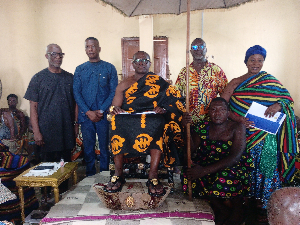 Members of the Obaapa Foundation with the paramount chief of the New Juaben Traditional Area






Opinions