Renowned British-Ghanaian architect Sir David Adjaye has reignited public debate over Ghana’s controversial National Cathedral project, insisting the initiative was a necessary national investment capable of transforming the country’s economic and cultural landscape.
Speaking during a Public Lecture Series at the Kwame Nkrumah University of Science and Technology’s (KNUST) Great Hall, Sir David Adjaye, the lead architect, described the stalled project as “a must project” for Ghana, stressing that the vision behind the cathedral extended far beyond religion.
The lecture, organised by the KNUST College of Arts and Built Environment under the theme “African Futures: Architecture, Identity, and the Power of Cultural Narratives,” drew students, academics, and industry professionals eager to hear from one of the world’s most celebrated architects.
During his presentation, the founder of Adjaye Associates lamented what he described as the lack of opportunity for his firm to publicly explain the broader vision and economic rationale behind the National Cathedral project.
“We have not been given an opportunity to share our side of the story,” he stated.
Referring to the project as one that had caused “heartaches,” Sir David Adjaye maintained that extensive research and economic projections strongly supported the initiative.
“The maths was clear when we saw the data,” he said. “Religious tourism is one of the most enduring stimulants of GDP. You want religious tourism to boost your growth. We must want it. The National Cathedral project was to serve as a great model for economic uplift.”
According to him, the proposed cathedral was envisioned as far more than a place of worship. He explained that the project would have transformed the landscape of Accra while positioning Ghana as a major destination for religious and cultural tourism.
“The cathedral was going to be the largest park in Ghana, creating a green belt in Accra and circulating major institutional infrastructure like Parliament and Independence Square,” he stated.
“It was going to be the highest building in Ghana. No matter where you stood in Accra, you would have seen it.”
Sir David Adjaye further argued that the project would have stood as a national symbol reflecting Ghana’s Christian majority.
“The National Cathedral project was going to become a symbol of a nation where 70 per cent of the people are Christians,” he added.
Responding to criticisms that the National Cathedral had become “the most expensive hole in the world,” Sir David Adjaye told Kumasi-based Pure FM journalist Evans Osei-Bonsu that the project was intended to become one of the world’s most extraordinary architectural landmarks.
According to him, the cathedral would have given Ghana and Accra a distinctive global identity while driving tourism and economic activity.
The National Cathedral project has remained one of Ghana’s most controversial public undertakings in recent years.
In July 2025, the Minister for Government Communications, Felix Kwakye Ofosu, disclosed that the abandoned project had already cost the Ghanaian state approximately $97 million, despite failing to reach completion.
The disclosure followed a directive by President John Dramani Mahama for auditing firm Deloitte & Touche to conduct an investigation into the project, which was initiated under the administration of former President Nana Addo Dankwa Akufo-Addo.
The public lecture held today at the KNUST Great Hall was chaired by the Vice-Chancellor of KNUST, Prof. Rita Akosua Dickson, and hosted by the Provost of the KNUST College of Arts and Built Environment, Prof. Christian Koranteng.
Sir David Adjaye was accompanied by the internationally acclaimed Ghanaian artist Ibrahim Mahama.
General News of Friday, 29 May 2026
Source: purefmonlinegh.com
'National Cathedral was a must for Ghana' – Sir David Adjaye
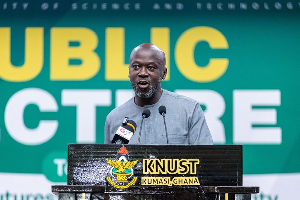 Sir David Adjaye is a renowned British-Ghanaian architect