The late Professor Francis Kofi Allotey was one of Ghana’s most celebrated scientists, whose mathematical physics work gained international recognition and contributed to the study of matter in outer space.
Born on August 9, 1932, in Saltpond in the Central Region, Professor Allotey developed an interest in science at a young age while helping his father at his bookstore.
His father, Joseph Kofi Allotey, was a merchant, while his mother, Alice Allotey, was a dressmaker. Raised as a Roman Catholic, he began his education at St John the Baptist Catholic Boys’ School in Saltpond.
His father’s bookstore played an important role in shaping his future. After school, young Allotey helped clean and arrange the shop, where he came across books about famous scientists and their work.
He became particularly interested in scientists such as Albert Einstein and Edwin Hubble and spent much of his free time reading about the universe.
“I was lucky that my father had a store, and as a young man in those days my duty is to open the store and then cleaning the place before I go to school. He sold books, textbooks, some fictions and also musical instruments,” he recalled in an interview.
“As I was reading or doing my cleaning the place then I'll be peeping through the books reading them and there I found names like Einstein, the way they were talking about the universe, the cosmology,” he said.
In July 1948, Allotey became part of the inaugural class of Ghana National College, a school established by Ghana’s first President, Kwame Nkrumah.
After completing his studies, he travelled abroad for further education, where he studied at University Tutorial College, London Borough Polytechnic, now South Bank University, and later at the Imperial College of Science and Technology in London.
He obtained a diploma from Imperial College in 1960 before moving to Princeton University in the United States, where he studied mathematical physics and earned his PhD.
Despite the opportunity to remain abroad after completing his studies, Professor Allotey returned to Ghana and began teaching mathematics at the Kwame Nkrumah University of Science and Technology (KNUST).
Professor Allotey went on to hold several important positions in Ghana’s scientific and academic community.
He served in leadership roles at institutions including the Ghana Atomic Energy Commission, the Council for Scientific and Industrial Research, the Ghana Academy of Arts and Sciences, the Mathematical Association of Ghana and the Ghana Institute of Physics.
He also played roles in international scientific organisations, including the International Union of Pure and Applied Physics, the African Institute for Mathematical Sciences and the African Academy of Sciences.
Throughout his career, he worked to promote mathematics, physics and computer science in Ghana and across Africa.
He also collaborated with mathematicians at Imperial College London to establish a network for mathematical research in developing countries.
One of Professor Allotey’s major scientific contributions was what became known as the Allotey Formalism.
The technique is used in the study of matter in outer space and has been linked to work by scientists, including those at NASA, to determine the composition of matter in space.
His work helped establish him as one of Ghana’s leading mathematical physicists and gave him recognition beyond Africa.
In 1973, he received the Prince Philip Gold Medal Award in the United Kingdom for his contribution to science.
Professor Allotey received several awards and honours during his lifetime.
In 2004, he was the only African among 100 eminent physicists and mathematicians featured in the book 100 Reasons to be a Scientist.
A year later, he received the Millennium Excellence Award for Science and Environment.
He was also honoured with the Order of the Volta, one of Ghana’s highest national honours. In 2017, he received the Osagyefo Kwame Nkrumah African Genius Award, while the Ghanaian government also issued a postage stamp featuring his portrait.
He chaired the Board of Trustees of the Accra Institute of Technology and served as president of the African Institute for Mathematical Sciences.
He was also a Fellow of the British Computer Society and an honorary fellow of the UK Institute of Physics and the Nigerian Mathematical Society.
General News of Sunday, 11 October 2026
Source: www.ghanaweb.com
Meet the Ghanaian whose research shed light on matter in space
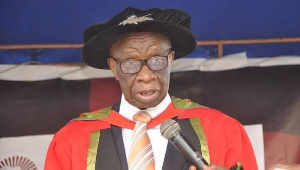 A photo of Professor Francis Kofi Allotey