The Lower Manya Krobo Municipal Assembly in the Eastern Region on Tuesday, August 25, 2026 presented livelihood support items to 35 Persons with Disabilities (PWDs) to help them establish or expand income-generating activities and improve their economic independence.
The items, distributed through the Department of Social Welfare and Community Development, included chest freezers, refrigerators, plastic chairs, mattresses, a cassava milling machine, bags of charcoal, gallons of cooking oil, crates of eggs, a knitting machine, sacks of maize and a wheelchair, among others.
The intervention forms part of the government’s Disability Common Fund, which is designed to reduce poverty among persons with disabilities and promote their participation in economic and social development.
The Common Fund for Persons with Disabilities was introduced in 2005 as a social protection intervention, with a key objective of supporting income-generating activities, education, technical aids and assistive devices for PWDs. The Ministry of Gender, Children and Social Protection says the fund is particularly intended to support persons with disabilities outside the formal employment sector and promote dignified livelihoods.
‘Disability is not inability’
Speaking at the presentation, the Municipal Chief Executive for Lower Manya Krobo, John Atter Matey, said the intervention was intended to provide beneficiaries with the means to become economically self-reliant rather than depend on others for their livelihood.
He said it was the second such distribution since he assumed office, following an earlier presentation in December, 2025 in which beneficiaries received items of their choice.
“We want to ensure that you do not beg. Disability is not inability. Many PWDs are fully employed and can also pursue education. Disability cannot stop you from working,” he said.
Matey urged the beneficiaries to regard the items as start-up capital and use them productively to build sustainable businesses capable of supporting themselves and their families.
The Assembly Chief cautioned beneficiaries against selling the items, saying the Assembly would undertake monitoring exercises to determine whether the support was being put to its intended use.
“If you do it well, you will soon be in a profitable business,” he said, adding that beneficiaries who failed to use the items appropriately could risk losing access to future support.
The MCE also dismissed concerns that the intervention constituted an inappropriate use of public funds, stressing that allocations meant for PWDs were specifically designated for their benefit.
Beneficiaries selected based on needs
The Chairman of the Persons with Disabilities group and the Social Welfare Committee, Bright Tetteh Tetteyku, said the 35 beneficiaries were allowed to identify the items they needed before procurement.
According to him, the approach was intended to ensure that beneficiaries received support relevant to their individual circumstances and business plans.
He advised the recipients not to sell the items but rather use them to improve their livelihoods and become financially independent.
Tetteyku disclosed that although the Disability Common Fund is expected to be disbursed quarterly, Lower Manya Krobo had experienced delays, resulting in fewer distributions than anticipated.
He said the Assembly was expecting further releases and procurement, with another distribution anticipated in approximately one and a half months.
Beneficiaries express appreciation
A former President of the Ghana Federation of Disability Organisations in Lower Manya Krobo and beneficiary, Isaac Partey Padi, expressed appreciation for the intervention, saying the refrigerator he received would enable him to establish a business.
He said previous beneficiaries he had visited were using their items for their intended purposes, with the support helping them to improve their livelihoods.
“I am happy with it. This one will help me to establish my business,” he said.
Padi, however, appealed to the Assembly and relevant authorities to ensure that the Disability Common Fund was disbursed regularly, noting that the support was expected to be provided quarterly.
He said delays in disbursement could affect the ability of PWDs to access timely assistance and expand their businesses.
Role of Disability Common Fund
The Disability Common Fund is not intended simply as a cash-sharing exercise. Its objectives include economic empowerment through support for income-generating activities, educational assistance for children, students and trainees with disabilities, capacity building for organisations of PWDs, and access to technical aids and assistive devices.
The fund has supported beneficiaries across Ghana with items such as deep freezers, sewing and knitting machines, corn mills, business stock, computers, wheelchairs and other assistive equipment. Recent distributions by other assemblies have similarly focused on helping PWDs establish businesses and improve their economic independence.
The intervention is therefore intended to address some of the barriers that PWDs face in accessing employment, productive assets and economic opportunities. By providing equipment and start-up support, the programme can enable beneficiaries to generate income, support dependants, employ others and participate more fully in community development.
The Ministry of Gender, Children and Social Protection has also emphasised that effective management and monitoring of the fund is necessary to ensure that the resources reach their intended beneficiaries and are used for their intended purposes.
For beneficiaries in Lower Manya Krobo, the latest distribution represents an opportunity to turn the support into sustainable livelihoods, with the Assembly urging them to protect the assets and use them productively rather than dispose of them for immediate financial gain.
Regional News of Wednesday, 26 August 2026
Source: www.ghanaweb.com
Lower Manya Krobo Assembly supports 35 PWDs with livelihood items
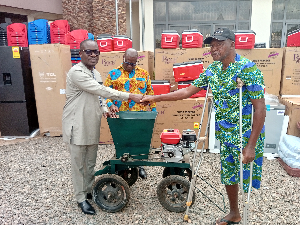 The Disability Common Fund support aims to reduce poverty and promote economic inclusion among PWDs