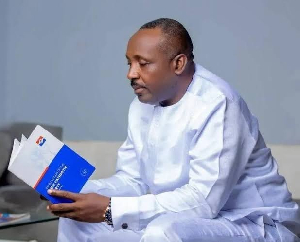
Legal scholar and good governance advocate, Professor Stephen Kwaku Asare, popularly known as Kwaku Azar, has weighed in on the ongoing legal debate over the Attorney General’s (AG) filing of proposed arguments challenging the jurisdictional powers of the Office of the Special Prosecutor (OSP).
According to him, Ghana’s Constitution does not centralise all prosecutorial authority in one office.
Deputy AG challenges OSP's jurisdictional bounds at the Supreme Court
He said the argument that only the AG can properly exercise prosecutorial power misreads both constitutional design and legal tradition.
“We are told that the Constitution should be read as barring Parliament from creating independent prosecutorial spaces,” he wrote in a lengthy post on Facebook on Friday, April 10, 2026.
Kwaku Azar rejected the idea that the AG must control every prosecution.
“That it must be read literally and understood as outlawing independent prosecutors. That the Attorney-General (AG) must be treated as an imperial figure whose hands must be present in all criminal proceedings,” he said.
He stated that such a position is inconsistent with legal history and common law practice.
“That proposition collapses under the weight of both history and doctrine. It is so at variance with our common law and, frankly, the common law across the Commonwealth that, with galactic respect, GOGO hereby rejects it,” he argued.
He explained that prosecutorial authority has long been shared among different actors in the justice system.
“Our common law has always accommodated the diffusion of prosecutorial authority. Private prosecutions were a foundational feature of the criminal process long before the modern state assumed a dominant role,” he argued.
Azar pointed to legal provisions that allow the AG to delegate prosecutorial functions to various public officers.
He also referenced past executive instruments that expand prosecutorial roles beyond the Attorney General’s office.
“Under section 56 of the Criminal and Other Offences (Procedure) Act, the AG is empowered to appoint public prosecutors generally, for classes of cases, or for particular matters. Acting under that provision, successive AGs have, by executive instrument, designated entire categories of public officers as prosecutors,” he noted.
“The Appointment of Public Prosecutors Instrument, 2004 (E.I. 5), for example, appoints lawyers within the ‘Internal Revenue Service, Customs, Excise and Preventive Service, and the Value Added Tax Service’ as prosecutors for offences arising under their respective statutes,” he added.
According to him, this shows a system where prosecution is institutionally shared rather than centrally controlled.
“These appointments reflect a working system in which prosecutorial authority is exercised within institutional mandates,” he stated.
He argued that the Constitution does not require all prosecutors to be directly appointed in a rigid format.
“The Constitution does not prescribe the mechanism of authorisation. It does not require that every prosecutorial actor be individually appointed by executive instrument. What it requires is that such authority be exercised “in accordance with law,” he indicated.
The good governance advocate further cited other statutes, including the National Pensions Act, to show how institutions can exercise legal authority independently within defined limits.
Kwaku Azar said these arrangements do not remove the AG’s constitutional role but instead create a shared system of enforcement.
“It authorises an officer of the Trust to institute and conduct proceedings in their own right for the recovery of contributions and penalties. These proceedings are grounded in statutory authority vested directly in the institution, not in the AG’s personal control or case-by-case direction.
“These arrangements reflect a settled distinction between ultimate constitutional responsibility and operational authority structured by law,” he noted.
He warned that interpreting the Constitution as giving the AG total control would distort the legal system, stressing that the Constitution allows specialised prosecutorial bodies like the OSP.
“To read Article 88 as freezing prosecutorial authority into a single political appointee would be to depart from both common law tradition and entrenched statutory practice. It collapses a functioning system into a one-man prosecutorial empire,” he stated.
“The Office of the Special Prosecutor Act fits squarely within that framework. It does not displace the AG; it channels prosecutorial authority through a statutory scheme tailored to corruption and corruption-related offences,” he continued.
He added that Ghana’s constitutional design supports shared prosecutorial authority, not centralised control.
“The Constitution did not create an imperial AG. Nor did it chain us to a prosecutorial system incapable of confronting executive looting. It created a system. And that system has always allowed prosecutorial and enforcement power to be structured, shared, and specialised. The attempt to rewrite it into a one-man empire is not interpretation. It is distortion,” he argued.
Background
The Deputy Attorney General (AG) and Minister of Justice, Justice Srem-Sai filed proposed arguments asking the Supreme Court to declare section 4(2) of the Office of the Special Prosecutor Act, 2017 (Act 959) unconstitutional and to strike it down to the extent of its unconstitutionality.
Section 4(2) of the Act requires the Attorney General to authorise the Special Prosecutor (OSP) to initiate and conduct prosecutions of corruption and related offences.
According to report by TheLawPlatform on Thursday, April 9, 2026, the deputy AG in the proposed statement of case filed on Wednesday, April 8, 2026, noted that the OSP has, since 2018, "been investigating such allegations and suspicions, and prosecuting the offences that relate to them, even without such requisite authorisation by the Attorney General."
Unpacking the legal battle on the unconstitutionality of OSP
The AG, in defence of his prosecutorial powers under Article 88 of the 1992 Constitution, argues that any prosecution by the State requires his authorisation, which Parliament cannot remove through ordinary legislation.
MAG/VPO
Ex Black Stars player accuses family of 'stealing' his 8 bedroom house:
General News of Friday, 10 April 2026
Source: www.ghanaweb.com
Kwaku Azar wades into OSP's jurisdictional bounds debate
 L-R: AG Dominc Ayine, Kwaku Azar and OSP Kissi Agyebeng



Entertainment