For many young scholars, research is just another academic requirement. For Juliana Kissiwah Somuah, however, it has become a powerful tool to shape how infrastructure, leadership, and management practices can transform lives.
From Ghana to the United States, her projects have not only earned recognition in international circles, but they have also positioned her as a future changemaker who intends to bring innovative solutions back home.
One of her notable studies, “Do Greater Qualifications Imply Higher Bid Costs,” for instance, explored a critical issue in the construction industry — whether highly qualified contractors inadvertently drive up project costs.
This work provided insights that can help Ghanaian policymakers and procurement bodies strike a balance between hiring qualified professionals and managing public spending efficiently.
In a country where infrastructure projects often face cost overruns, Somuah’s findings hold potential for reforming tendering processes to ensure both quality and value for money.
Her research has also delved into the people behind the infrastructure.
In another work of hers, “Comparing Human Traits and Tendencies: A Study of Facility Managers and Procurement Professionals,” Somuah examined how personality traits shape decision-making in these two professions.
The implications have been far-reaching: by understanding behavioral tendencies, Ghana’s construction and facilities management industries can foster better collaboration, reduce conflicts, and improve efficiency in project delivery.
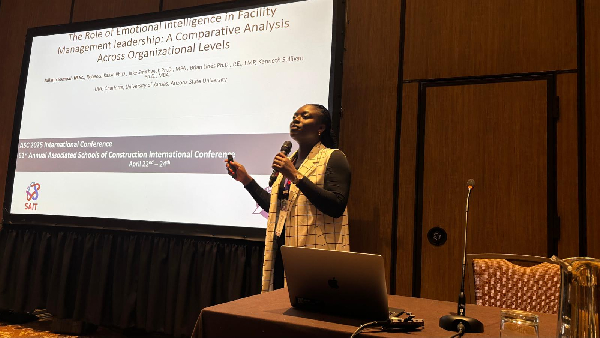
Going further, her book contribution, “Global Trends of Facility Management,” places her at the center of global discussions on the future of built environments.
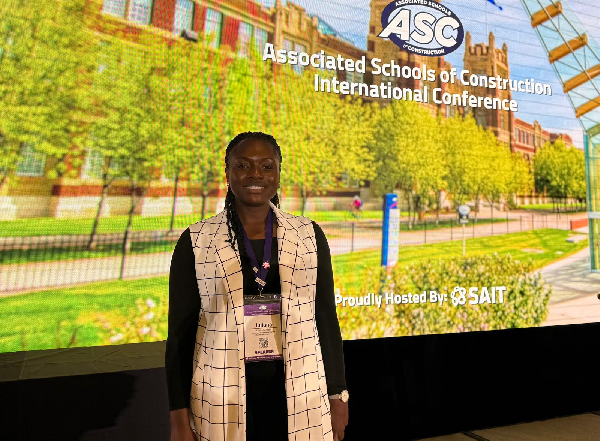
Here, she helps identify how emerging trends — such as sustainability, digitalisation, and new workplace models — can inform local practices. For Ghana, where facility management remains an underdeveloped field, her work provides a roadmap for adopting international best practices while tailoring them to local needs.
Somuah’s master’s thesis, “An Assessment of Personality Profiles of Facility Managers in the United States,” extends her commitment to understanding leadership beyond technical expertise.
By analyzing the personality dynamics of professionals managing critical facilities, she highlights how emotional intelligence and human-centered leadership can transform organizational outcomes.
Relating it to the Ghanaian environment, where leadership challenges often undermine technical projects, this research offers a reminder that infrastructure development is not just about concrete and steel — it is also about people.
She has also co-authored, “Insights into the Personalities of Facility Managers: The People Behind the Facilities,” a publication that brings to life the often-overlooked human aspects of engineering and management.
It reinforces her core belief that technical industries thrive when human behavior and professional competence are integrated, a philosophy she hopes to apply in developing Ghana’s future engineering leaders.
Through these projects, Juliana Kissiwah Somuah is carving a space for herself as more than an academic. Her research bridges the gap between technical systems and human behavior, between global trends and local needs.
Ultimately for Ghana, her journey signals the rise of a new generation of scholars who are not only excelling abroad, but are preparing to return home equipped with knowledge, insights, and a deep commitment to national transformation.
Juliana Kissiwah Somuah’s story is one of determination, focus, and a relentless drive to equip herself with the skills needed to create lasting change in Ghana and the world.
What she is achieving for herself is that from the lecture halls of Kwame Nkrumah University of Science and Technology (KNUST) to her current PhD journey at the University of North Carolina at Charlotte, Somuah is charting a path defined by academic excellence and a vision for impact.
She also remains committed to tackling complex challenges in engineering, infrastructure, and sustainability, all in an attempt to remain a positive changemaker in the world.
General News of Friday, 10 January 2025
Source: www.ghanaweb.com
Juliana Somuah: Building a future to inspire change in Ghana and beyond
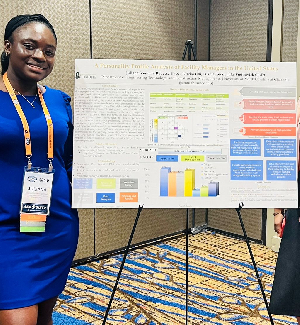 Juliana Somuah is making impacts on the global stage



Entertainment