The Christian Council of Ghana (CCG) has raised concerns over a series of conflicting political prophecies that emerged following the 2026 New Patriotic Party's (NPP) Presidential primaries, calling for a more responsible and accountable religious environment in 2026 and beyond.
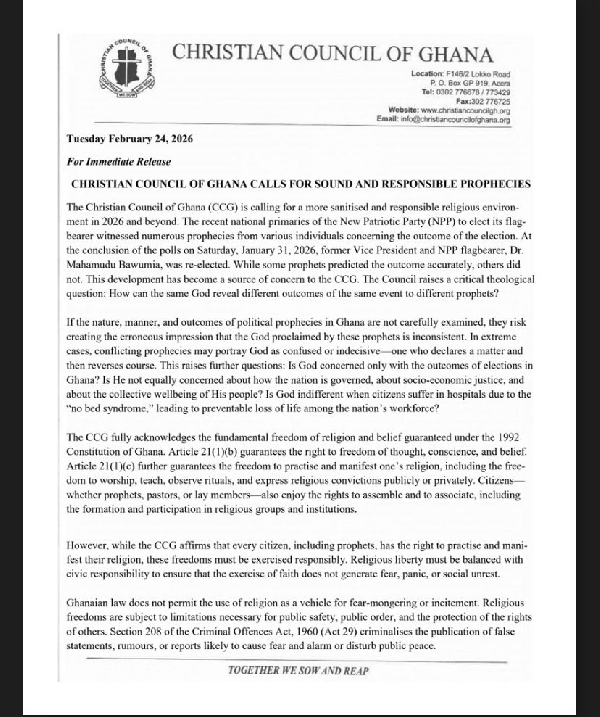
In a statement dated February 24, 2026, and signed by Rev Dr Cyril Fayoe, General Secretary of the CCG, the Council pointed to the wave of prophecies surrounding the January 31, 2026, polls, which saw former Vice President Dr Mahamudu Bawumia re-elected as the NPP flagbearer.
"While some prophets predicted the outcome accurately, others did not. This development has become a concern for the CCG. The Council raises a critical theological question: How can the same God reveal different outcomes of the same event to different prophets?" the statement read.
I have paused on making public prophetic declarations - ElBernard
The Council noted that these conflicting prophecies, if left unchecked, could give the impression that God is inconsistent or indecisive, pointing out that in extreme cases, they may depict a deity who declares a matter and then reverses course.
It warned that such messages could undermine the credibility of prophetic voices and create confusion among the public.
The CCG questioned whether prophetic attention has become too narrowly focused on political events.
“Is God concerned only with the outcomes of elections in Ghana? Is He not equally concerned about how the nation is governed, about socio-economic justice, and about the collective well-being of His people?
"Is God indifferent when citizens suffer in hospitals due to the 'no bed syndrome,’ leading to preventable loss of life among the nation's workforce?" the statement asked, calling for prophetic engagement with broader societal issues such as corruption, governance, and public welfare.
While reaffirming the constitutional right to freedom of religion, belief, and assembly under Articles 21(1)(b) and 21(1)(c) of the 1992 Constitution, the Council emphasised that these freedoms must be exercised responsibly.
It cautioned that religious liberty should be balanced with civic responsibility to prevent fear, panic, or social unrest.
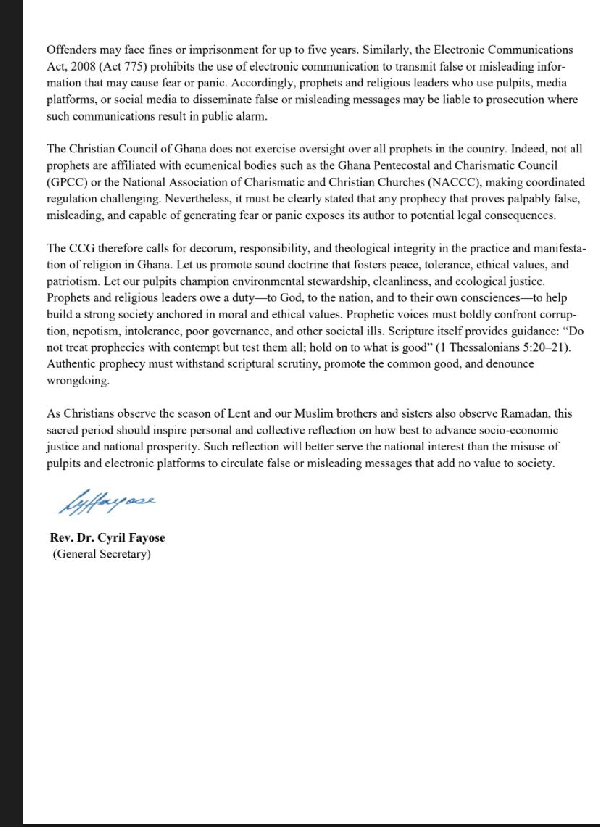
The statement also underlined the legal limits on religious expression in Ghana, citing Section 208 of the Criminal Offences Act, 1960 (Act 29), which criminalises the publication of false statements, rumours, or reports likely to cause fear or disturb public peace, punishable by fines or up to five years' imprisonment.
Additionally, the Electronic Communications Act, 2008 (Act 775), prohibits the dissemination of false or misleading information through electronic platforms.
The Council warned that prophets or religious leaders who spread misleading messages via pulpits, media, or social media could face legal consequences if their communications incite public alarm.
Acknowledging that the CCG does not oversee all prophets in the country, especially those outside ecumenical bodies like the Ghana Pentecostal and Charismatic Council (GPCC) or the National Association of Charismatic and Christian Churches (NACCC), Rev Dr Fayoe emphasised that "any prophecy that proves palpably false, misleading, and capable of generating fear or panic exposes its author to potential legal consequences."
FULL DOCUMENTARY! S3X and Spirits: The ‘Dark Side of Kayamata’ ruining lives
AK/
General News of Wednesday, 25 February 2026
Source: www.ghanaweb.com
How can God reveal different outcomes to different prophets? - Christian Council asks
 Logo of the Christian Council of Ghana