Former Ghanaian President Dr Kwame Nkrumah’s vision for a united and self-reliant Africa has resurfaced in global discussions following a New York Times report that revisited his historic ties with former US President John F Kennedy.
According to nytimes.com report on August 19,2025, not long after Kennedy took office, he selected Nkrumah as the first foreign leader to visit the White House, underscoring Africa’s early significance in US foreign policy during the 1960s.
The move reflected Kennedy’s belief that Africa, with its vast resources and young population, represented a continent full of promise.
“But even as a senator, Kennedy had begun to see Africa with its enormous landmass, newly independent countries and young population as a continent full of promise”, the report said.
See this rare photo of young Kwame Nkrumah and his mother
According to the report, Kennedy mentioned Africa nearly 500 times during his 1960 presidential campaign speeches, showing his determination to engage the region amid growing Cold War competition.
“By one count, during his presidential campaign speeches in 1960 he mentioned Africa 479 times. As president, he was keen to compete for influence there with the Soviet Union and even side with anticolonialism, courting tension with America’s European allies”, the report indicated.
Nkrumah, who led Ghana to independence in 1957, became one of Kennedy’s most trusted partners on African affairs.
Following Kennedy’s assassination, US interest in Africa declined sharply. Washington’s policy narrowed to Cold War competition with Moscow, with limited attention to democracy or long-term development.
In later decades, American involvement was largely confined to humanitarian assistance.
The report observed that other global powers have also scaled back their engagement with Africa. France has reduced its presence in parts of West Africa, while China’s investments have plateaued after years of expansion.
These shifts reaffirm Nkrumah’s belief that Africa’s progress depends on unity and self-reliance.
Though his proposals for continental federation were dismissed at the 1963 founding of the Organization of African Unity, his vision of integration and cooperation continues to resonate as Africa’s population grows and global attention fades.
“One surprising source for this vision was the Federalist Papers. While he was a college and graduate school student in Pennsylvania in the 1930s and ’40s, Nkrumah became deeply familiar with the history of how a group of small colonies bound themselves together to forge an independent, federal country that became much richer and stronger than the sum of its parts. This was the future he saw for his continent, as he explained to his peers at the founding summit of the Organization of African Unity, held in Addis Ababa, Ethiopia, in 1963. Nkrumah’s fellow leaders rejected his idea. But the continent’s subsequent history six decades of deprivation, poverty and corruption has laid bare the costs of having a plethora of small countries that largely turn their backs to one another. In the absence of collaboration, they remain poor and condemned to engage as weaklings with the outside world”, the report said.
Kwame Nkrumah@116: The legacies of Ghana's 1st President
With no one in the world serving up favors to the continent, Nkrumah’s insight about the gains to be had through federation is as salient as ever. What is lacking is sufficient action. The time has come for a continent cut loose in the world to take the next step.
MRA/EB
'She Smokes Wee': Ex-SHS assistant head speaks on KNUST SHS student in viral video
General News of Saturday, 4 October 2025
Source: www.ghanaweb.com
How Nkrumah’s vision still resonates today
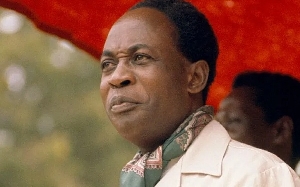 Dr Kwame Nkrumah was the first president of Ghana