The government has tasked Regional and District Security Councils (REGSECs and DISECs) to strengthen intelligence gathering, early warning systems and inter-agency cooperation to address emerging security threats under the Security and Intelligence Agencies Act, 2026 (Act 1168).
The Deputy Minister for the Interior, Ebenezer Okletey Terlabi, said effective implementation of the new law was critical to strengthening Ghana's security architecture and ensuring that security institutions were better equipped to prevent and respond to threats.
He was speaking at a training workshop for members of the Eastern Regional Security Council (REGSEC), Metropolitan, Municipal and District Chief Executives (MMDCEs), and chairpersons of District Security Councils in Koforidua on Wednesday, November 25, 2026.
The workshop formed part of a nationwide engagement to familiarise regional and district security stakeholders with the provisions of Act 1168 and their respective responsibilities under the new legal framework.
Terlabi, who addressed the participants on behalf of the Minister for the Interior and Minister responsible for National Security, Muntaka Mohammed-Mubarak, said the success of the security reforms would ultimately depend on their impact on safety and security in communities across the country.
He identified illegal mining and environmental destruction around the Atewa Forest Reserve and the Birim River, chieftaincy and land disputes, farmer–herder conflicts, armed robbery, drug-related offences, cybercrime and youth violence as some of the security concerns requiring sustained attention in the Eastern Region.
He called on REGSEC and DISEC members to prioritise early intervention, strengthen community-level vigilance and ensure that security meetings produced concrete decisions and measurable outcomes.
"Security concerns must not be repeatedly discussed without meaningful action," he stressed, urging security agencies and public officials to discharge their responsibilities professionally and without political interference.
The Deputy Minister further called for sustained enforcement against illegal mining, particularly in environmentally sensitive areas, and urged local authorities to work closely with traditional leaders and relevant security agencies to prevent chieftaincy, land and farmer–herder disputes from escalating into violence.
He also cautioned against the use of intimidation and the mobilisation of youth to enforce claims or settle disputes, insisting that all grievances must be addressed through lawful processes.
National Security calls for intelligence-led approach
In a separate address delivered on behalf of the National Security Coordinator, the Deputy National Security Coordinator, Major General William Ayamdo (Rtd.), urged regional and district security structures to move beyond responding to incidents and develop the capacity to anticipate and prevent threats.
He said effective security management required a disciplined process of gathering information, assessing its credibility, identifying emerging patterns and ensuring that relevant intelligence reached the institutions responsible for taking action.
He cited illegal mining activities around the Atewa Range Forest Reserve and the Birim River, farmer–herder conflicts, chieftaincy and boundary disputes, school violence, youth-related crime and cybercrime as threats requiring coordinated attention.
On illegal mining, Major General Ayamdo said security operations should go beyond arresting individuals at mining sites to identifying and disrupting the networks, financing arrangements and supply chains that sustain the illegal activities.
He outlined five priorities for REGSEC and DISEC, including strengthening early warning and threat reporting, improving intelligence assessment, enhancing coordination across district boundaries, ensuring that decisions translate into action and protecting the integrity of intelligence operations.
He also cautioned against the politicisation of intelligence and the use of security information to settle personal disputes, emphasising that sensitive information must be handled responsibly and all interventions conducted within the law.
Eastern Regional Minister urges vigilance ahead of Christmas
The Eastern Regional Minister and Chairperson of REGSEC, Rita Akosua Adjei Awatey, called on security stakeholders to deepen collaboration and strengthen measures to maintain peace and public safety, particularly as the Christmas season approaches.
She identified illegal mining, chieftaincy disputes and farmer–herder conflicts among the security challenges confronting the region and commended members of REGSEC and the Municipal and District Security Councils for their efforts in maintaining law and order.
She urged participants to use the workshop to improve their understanding of the new law and strengthen their capacity to undertake security assessments, share intelligence, establish effective early warning mechanisms and coordinate timely responses to emerging threats.
The workshop featured sessions on the statutory responsibilities of REGSECs, DISECs and MMDCEs, the national and regional security threat landscape, the constitutional and legal framework underpinning Act 1168, accountability and oversight obligations, complaints procedures and warrants.
Resource persons included International Security Advisor Major General Kotia (Rtd.) and Professor Raymond A. Atuguba, Programme Director and Managing Partner of A&A.
The engagement also provided an opportunity for participants to discuss implementation challenges, identify immediate security priorities and agree on action points to improve coordination among regional and district security structures.
Regional News of Wednesday, 25 November 2026
Source: www.ghanaweb.com
Government tasks REGSEC, DISECs to strengthen security coordination under new law
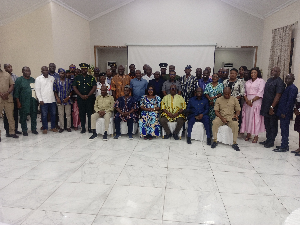 Government has tasked REGSECs and DISECs to strengthen security intelligence and cooperation