A mining consultant and policy analyst, Wisdom Edem Gomashie, has urged the government to renegotiate the terms of the Tarkwa Mine lease renewal with Gold Fields, instead of rejecting the company’s application outright, warning that abrupt resource nationalism could damage investor confidence in Ghana’s mining sector.
In a detailed statement responding to concerns raised by the Institute of Economic Affairs (IEA) over the planned renewal of the Tarkwa Gold Mine lease, Gomashie argued that Ghana currently lacks the financial and technical capacity to independently operate a large-scale mine such as Tarkwa.
He maintained that while calls for greater Ghanaian participation in the mining industry were legitimate, any move toward localisation or nationalisation must be backed by clear laws and long-term policy frameworks, rather than decisions taken at the point of lease expiry.
“The government’s localisation agenda, in the national interest, must be grounded in policy and law and not triggered solely at the point of lease expiry for companies,” he stated.
The mining consultant proposed that the government renegotiates stronger participation terms with Gold Fields, including an additional 30% equity stake for the state and Ghanaian interests beyond the state’s existing 10% carried interest.
Davis Opoku Ansah opposes Gold Fields lease renewal
He also recommended that the lease extension be limited to an initial period of 10 years instead of a longer-term renewal.
According to him, such an arrangement would allow the state, citizens, and local contractors to gradually build capacity, while maintaining investor confidence and operational stability at the mine.
Gomashie further called for legislation to establish a Community Development Fund financed through 1% of the mine’s gross revenue to support development in host communities affected by mining operations.
He stressed that mining communities had for decades complained about underdevelopment despite the vast wealth generated from mineral extraction.
Citing figures from his academic research at the University of Mines and Technology, Wisdom Gomashie said Ghana exported about US$68.8 billion worth of major minerals between 1990 and 2019, while government earnings from royalties, taxes, and related revenues amounted to only US$6.6 billion.
He said this reflects the need for Ghana to pursue stronger equity participation models rather than abrupt takeover attempts.
The mining consultant warned that denying lease renewals without clear legal or policy justification could create uncertainty within the mining sector and discourage foreign direct investment.
He noted that mining projects are long-term, capital-intensive ventures requiring billions of dollars in financing, adding that investors rely heavily on legal guarantees and regulatory stability when committing funds.
He referenced Ghana’s decline in the 2025 Fraser Institute Global Mining Investment Attractiveness Index, where the country reportedly dropped from 46th position in 2024 to 53rd in 2025 due largely to policy uncertainty.
The mining consultant argued that Ghana should instead emulate countries such as Botswana, Chile, and Norway, where governments maintain significant participation in resource extraction through state-backed investment vehicles and joint venture arrangements.
He suggested that the Minerals Income Investment Fund could be strengthened to take strategic equity stakes in large mining projects.
Wisdom Gomashie also proposed the establishment of a national mining company under the Minerals Income Investment Fund to coordinate state participation in future mineral exploitation, projects alongside multinational companies.
While acknowledging the IEA’s concerns about sovereignty over Ghana’s mineral resources, he cautioned against what he described as “abrupt populist interventions” driven by resource nationalism without clear implementation structures.
“The recommendation for outright rejection of the lease renewal application without recourse to Act 703 and other codified policy transition frameworks risks creating a bad image for Ghana capable of deterring future mining investments,” he stated.
Gold Fields, according to him, has invested heavily in the Tarkwa Mine over the past three decades, transforming it from an ageing underground operation into one of Africa’s largest open-pit gold mines producing about 500,000 ounces annually.
He added that the company had reportedly invested about US$5 billion into the operation while contributing approximately US$3.3 billion to the Ghanaian state through taxes, royalties, dividends, and PAYE.
AE
Business News of Saturday, 16 May 2026
Source: www.ghanaweb.com
Government should renegotiate terms with Gold Fields - Gomashie
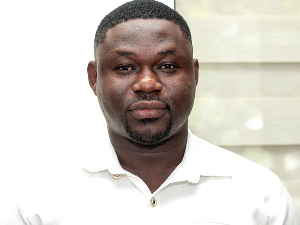 Wisdom Edem Gomashie is a mining consultant