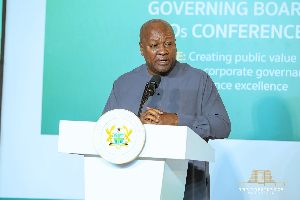
While delivering government’s mid-year fiscal policy review for 2026, the Finance Minister, Dr Cassiel Ato Forson also provided a detailed plan for the implementation of the Policy Coordination Instrument (PCI) which the government and the International Monetary Fund have agreed to work together on over the next 36 months.
The PCI will kick off immediately following the formal approval, expected by the end of his month, by the IMF’s Executive Board of the Staff-Level Agreement reached on May 15, 2026 on the Sixth and Final Review of the three-year Extended Credit Facility (ECF) Programme.
Upon approval, Ghana will receive the final tranche of approximately US$370 million, bringing total disbursements to the full US$3 billion committed when the programme was approved in May 2023.
Dr Forson asserted that Ghana has met nearly all the targets set under the ECF. “Every quantitative performance criterion, but one, set for the final review has been met: the floor on net international reserves of the BoG was met; the ceiling on the present value of newly contracted or guaranteed external debt by central government and public entities was met; the floor on the primary fiscal balance of the central government on a commitment basis was met; the ceiling on non-accumulation of external debt payments arrears by central government and the Bank of Ghana was met; and the ceiling on newly contracted collaterised debt by central government and public entities was also met.”
He revealed that the ceiling on changes to the Bank of Ghana’s claims on the central government and public entities was the only Quantitative Performance Criterion (QPC) that was not met explaining that this was as a result of the accounting treatment of the government GH¢5 billion recapiltalisation bond that was issued to the Bank of Ghana.
The Finance Minister further claimed that every indicative target and almost every structural benchmark have also been achieved. Altogether Ghana achieved 10 out of 11 quantitative targets and 8 out of 10 structural benchmarks
However, “completing the ECF does not mean Ghana walks away from the IMF as Ghana is an IMF-member country. It means Ghana changes the nature of the relationship.” Dr Forson explained
“As Ghana moves beyond the Extended Credit Facility, our engagement with the International Monetary Fund will transition to a reform-focused, non-financing Policy Coordination Instrument. As part of the Sixth Review discussions, Government has requested a 36- month Policy Coordination Instrument (PCI), to take effect once the ECF programme concludes.”
The Policy Coordination Instrument is a non-financing IMF instrument designed for countries that do not require IMF financing but seek a credible framework for reform, regular policy reviews, and a stronger signal to investors and development partners.
“The PCI will enable us to continue leveraging the IMF’s regular policy assessments and expertise as a signal to investors, thereby certifying the credibility of our stewardship and further strengthening our credit rating” the Finance Minister further asserted.
“This is a structured internationally monitored platform through which Ghana commits to a specific set of macroeconomic and structural reform policies, submits to regular independent review, and signals to the world that the discipline of the past eighteen months is not a temporary posture adopted under crisis conditions. It is a permanent feature of how this country will be governed."
The PCI is anchored on six broad pillars that together define the architecture of Ghana’s post-crisis economic management:
The first pillar is sustaining growth-friendly fiscal adjustment;
The second pillar is safeguarding debt sustainability;
The third pillar is strengthening fiscal transparency and governance;
The fourth pillar is enhancing the monetary and exchange rate policy framework;
The fifth pillar is reinforcing financial sector stability; and
The sixth pillar is supporting economic diversification and inclusive growth.
Claims Dr Forson: “The overarching objectives remain to reinforce macroeconomic resilience with focus on: safeguarding public debt sustainability while creating space for priority spending by strengthening domestic revenue mobilization and making spending more growth friendly; strengthening social safety nets; implementing a more flexible exchange rate regime; pursuing a forward-looking, data-driven monetary policy; and bolstering stronger and more inclusive growth, while reducing youth unemployment and poverty.”
Under the PCI, before the end of June 2027, the Ghana Revenue Authority is to complete a comprehensive review of the income tax legislation to strengthen revenue mobilization and improve the efficiency and fairness of the tax system.
Within the same time frame the Ministry of Finance is to publish a new Medium Term Revenue Strategy (MTRS (2027-2030) to Improve revenue mobilization; review the SOE portfolio and re-classify all entities to appropriate categories – these comprising commercial or having potential to operate commercially, mixed mandates and general government units – to improve SOE governance; ensure publication of 2026 audited financial statements for the public entities to Improve fiscal governance; fully operationalize the Value for Money Office to strengthen public investment management practices and improve efficiency of spending; and extend GIFMIS coverage to all spending units and enforce its use by National Health Insurance Fund, Ghana Education Trust Fund, Road Maintenance Trust Fund, District Assemblies Common Fund and Internally Generated Fund-reliant institutions to strengthen budget execution and expenditure controls.
Before the middle of next year, the Public Procurement Authority is to publish the 2026 procurement report identifying the value of procurement by MDAs under each procurement method, to strengthen Public Financial Management procedures by reducing vulnerability to corruption.
By the end of 2027 based on the review of the SOE portfolio and reclassification of all entities, Cabinet will decide on restructuring, consolidation, commercialization, or divestiture of the relevant enterprises, while government will adopt a merit-based selection process to appoint the Boards and Executive Management of the SOEs to ensure that their members are selected competitively and based on the highest professional standards in line with best practices.
The Ministry of Finance will require the use of the GHANEPS-GIFMIS integrated system for all SOEs with central government appropriation, to strengthen Public Financial Management systems and cash flow management.
The Ministry will also conduct a review of the Treasury Single Account (TSA) model and prepare an updated TSA strategy for Cabinet approval, to strengthen PFM systems and cash flow management.
According to Dr Forson, under the PCI, government’s medium-term fiscal framework will continue to be anchored on the fiscal rules established under the recently amended PFM Act. 518.
The debt-to-GDP ratio, as set in the Public Financial Management (Amendment) Act, 2025 (Act 1136) – which sets the ceiling at 45 percent from 2034 – will continue to serve as the principal fiscal anchor.
Accordingly, while maintaining a steadfast commitment to fiscal discipline to preserve debt sustainability, Government will, under the PCI, seek to reduce the primary surplus target on a commitment basis from 1.5 percent of GDP to 0.5 percent of GDP from 2027 onwards.
Business News of Saturday, 25 July 2026
Source: businesspostonline.com
Government outlines post IMF programme PCI game plan
 The PCI programme will kick off immediately after formal approval