Ghana recorded a net financial outflow of about US$9.5 billion in the first nine months of 2026, more than US$3 billion above the country’s entire current account surplus, Bank of Ghana (BoG) data show. The outflow reflects a build-up of foreign assets, led by banks and private companies, together with repayments of external debt.
The figures help explain one of the central puzzles in the economy this year: how a country running a strong trade surplus could still see its foreign exchange reserves decline.
According to the BoG’s Summary of Economic and Financial Data, released on November 17, Ghana recorded a current account surplus of US$6.48 billion, equal to 4.9 per cent of GDP, between January and September 2026. Over the same period, the financial account, excluding reserve assets, recorded a net balance of US$9.53 billion, or 7.2 per cent of GDP.
The BoG compiles its balance of payments under the International Monetary Fund’s sixth Balance of Payments Manual (BPM6). Under that framework, a positive financial account balance means net lending by Ghana to the rest of the world, or money moving out.
The figure combines two kinds of flows. It rises when residents acquire assets abroad, such as deposits held with foreign banks, loans to non-residents and foreign securities. It also rises when the country reduces its foreign liabilities, for example by repaying external loans. Ghana’s external debt fell from US$29.4 billion at the end of 2025 to US$28.8 billion in September, according to the BoG, indicating that part of the outflow reflects debt repayment.
The current account measures what the country earns from the world, through exports, services, income and transfers. The financial account shows what happens to that foreign exchange afterwards. On the BoG’s figures, more left the country through the financial account than the economy earned.
The gap between the two, about US$3.06 billion, coincided with a fall in gross international reserves. These fell from US$13.83 billion at the end of December 2025 to US$12.07 billion in September, a decline of about US$1.76 billion. Movements in reserves also reflect changes in the value of assets such as gold, so the two figures do not match exactly. The direction, however, is clear.
The Governor of the BoG, Dr Johnson Pandit Asiama, has also attributed the decline in reserves to the Middle East crisis, higher oil prices and tighter global financing conditions.
The outflows have also been accelerating. The financial account balance stood at US$3.01 billion at the end of March and US$6.73 billion at the end of June. That implies a net outflow of about US$2.80 billion in the third quarter alone, compared with a current account surplus of about US$1.65 billion over the same three months.
The BoG has identified the main source of the build-up in foreign assets. In its July 2026 Monetary Policy Report, it said that in the first half of the year, “Other investments” recorded net outflows of US$8.02 billion, largely reflecting increased accumulation of foreign financial assets by commercial banks and the private sector
“Other investment” is the part of the financial account that covers currency and deposits, loans and trade credit. It is distinct from foreign direct investment (FDI), where investors take lasting stakes in companies, and from portfolio investment in shares and bonds. In practice, it captures banks placing funds with correspondent banks abroad, companies keeping export proceeds in foreign accounts, and trade credit extended to foreign buyers.
The inflows on the other side of the ledger have been modest. Foreign direct investment liabilities, the money foreign investors put into Ghanaian companies, amounted to US$1.74 billion in the nine months.
Portfolio investment liabilities were negative at US$153.8 million, indicating that non-residents reduced their holdings of Ghanaian securities on a net basis.
The trade balance showed a surplus of US$12.93 billion between January and September, while inward private transfers, mostly remittances, brought in US$5.33 billion. Yet the current account surplus was just US$6.48 billion.
Calculation from the BoG figures, that implies net payments of about US$11.8 billion on services and income. These include freight, insurance and other services, interest on external debt and profits repatriated by foreign-owned companies such as mining firms. The BoG table does not break these items down, so the figure is indicative.
The Governor acknowledged the problem at the press briefing after the 133rd Monetary Policy Committee (MPC) meeting in Accra on Wednesday.
“There is some gap when it comes to what’s happening to our trade and current account, versus the reserves build-up, that is, what is happening in the financial account,” he said. “The Monetary Policy Committee is aware of these. We are into discussions on these.”
He said the Bank was working “to increase the alignment between what we see in the trade and current account versus what we see by way of the balance of payments, the overall balance.”
Lower returns at home may be one factor. Treasury bill yields have fallen sharply, to 4.62 per cent on the 91-day bill in October, while the cedi has depreciated by about 10.6 per cent against the US dollar this year. Both conditions typically encourage banks and companies to hold more of their funds in foreign currency abroad.
Not all, of the outflow is necessarily a loss to the economy. Debt repayments reduce what the country owes, and foreign assets held by Ghanaian banks remain claims that can, in principle, be brought home. But such assets are not under the central bank’s control and cannot be used directly to defend the cedi.
The figures matter for the BoG’s reserve strategy. Under the Ghana Accelerated National Reserve Accumulation Policy, government is targeting reserves of 15 months of import cover by end-2028. The Governor has already conceded that the interim target of 8.6 months for December 2026 will not be met.
The data suggest the challenge is not only earning more foreign exchange through gold and other exports, but keeping more of it inside the domestic financial system.
Business News of Thursday, 26 November 2026
Source: economytimesnews.com
Ghana records US$9.5 billion net financial outflow in nine months
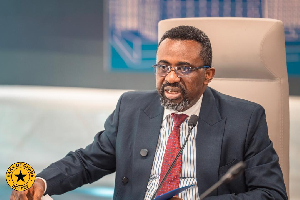 Dr Johnson Asiama is the Governor of Bank of Ghana