Imagine a farmer in the Upper West Region who has produced premium organic fruit or vegetables, or an agro-processing factory in Sunyani ready to ship raw materials processed into semi-finished or finished goods to Europe.
Before a single item can cross an international border or hit a supermarket shelf in Europe, it must pass through a solitary office at Accra-Shiashie – simply because Ghana Standards Authority has no offices in the regions’ districts and laboratories.
This is the plight of manufacturers, exporters and small-scale producers in Tamale, Takoradi, Bolgatanga, Sunyani, Dambai, Keta and beyond, as each day someone from these areas makes the same long journey to Accra carrying samples of agricultural produce, natural minerals, herbal medicines, food and cosmetics for GSA certification and a sticker.
If you produce anything that must be certified before it can be sold locally or shipped abroad, you have no choice but taking it to GSA’s office in Accra and then wait – sometimes for weeks – as the regulator’s understaffed workforce struggles to clear the backlog.
They are not coming for a conference or a trade fair, they are coming because only Accra houses the country’stesting laboratories.
The Director-General of Ghana Standards Authority (GSA), Prof. George Agyei, has disclosed the agency’s inadequate human capital status and its impact on operations, highlighting the need for urgent government intervention to improve national standards.
Addressing the Parliamentary Select Committee on Industry, Trade and Tourism in Accra, the D-G mentioned that the authority currently has no district offices across the country or regional laboratories, with just about 1,000 staff – a situation that is inhibiting its core mandate of testing, inspection and certification.
The roughly 1,000 staff sounds large only until you understand the mandate. Under the new Ghana Standards Authority Act, 2022 (Act 1078), the authority is responsible for developing and enforcing compulsory standards across all sectors; carrying out comprehensive market surveillance; conducting conformity assessments through testing, inspection and certification; issuing administrative penalties for non-compliance; and collaborating internationally to align with global trade standards. It also anchors industrial support, training and protection of consumers from sub-standard products.
He emphasised that with the GSA office in Accra hosting the only laboratories for all technical operations and conformity, all production activities across the country need to be brought to Accra – creating traffic that leads to long delays and preventing the expansion of oversight to all districts and regions.
Additionally, the authority has no staff at most of the key land borders where, usually, sub-standard goods are smuggled into the country.
This factor is partly responsible for the influx of contaminated and poor-quality materials on the local market, which has become harmful to consumers.
He lamented that the nation’s ‘mother of all regulatory bodies’ is operating on selective standardisation, crippled by severe understaffing and a drastic lack of decentralised infrastructure.
A lone standards laboratory for an entire nation
Addressing lawmakers, the D-G laid bare the human capital and logistical challenges: revealing that the Authority, which governs everything from the safety of the medicine we take to the calibration of the fuel pumps at our gas stations, operates with just about 1,000 staff members for the entire country.
Worse still, GSA completely lacks regional laboratories and operational district offices in all 16 regions of Ghana.Ghana Economic Forum
Every manufactured product requiring testing, inspection and certification must physically travel down the country’s choked transport arteries to the sole GSA laboratory hub in Shiashie-Accra.
“All production samples from across the country must be brought to Accra, creating a traffic-jam of commerce that leads to long delays,” Prof. Agyei said.
This logistical shortfall does more than just delay paperwork, it actively hinders small and medium enterprises (SMEs) outside the capital from certifying their products for export. It also creates uncertainty about the quality of their products, which is killing their competitive edge in both the local and export markets.
While plans exist to establish a vital middle-belt laboratory in Kumasi, the project remains stalled due to a severe lack of resources.
24-hour economy and AfCFTA success
Economic development is no longer just about producing goods; it is also about trust – and if a country cannot guarantee the safety, measurement and quality of its products, global markets will simply shut their doors.
Chairman of the GSA Governing Board, Alhaji Hudu Mogtari, on his part highlighted that government’s flagship 24-hour economy policy and the nation’s export competitiveness under the African Continental Free Trade Area (AfCFTA) may be under serious jeopardy if products cannot be measured, tested and certified before export.
“The 24-hour economy cannot thrive without standardisation and certification that meets international standards. The goods and services we produce must be trusted and that trust only comes when they can be measured against accepted global benchmarks,” he said.
He indicated that GSA is not only short of technology but also lacks ultra-modern technology necessary to carry out some specific testing – like the specific content of some components in cement.
He revealed that some of the current ultra-modern equipment being used was donated to the authority by the German government.
Head of International Relations at GSA, George Anti walked lawmakers through the authority’s functions: setting the standards that even the Food and Drugs Authority (FDA) uses for its certifications; calibrating fuel pumps for the Petroleum Commission and energy meters for ECG; verifying import certificates of conformity; awarding the Made-in-Ghana logo; certifying organic products; and conducting vehicle homologation.
All of this, he noted, rests on laboratories concentrated in one location and on a staff that is stretched dangerously thin.
“We have plans to establish a middle-belt laboratory in Kumasi to relieve the pressure and bring services closer to industry,” Anti disclosed.
Parliamentary Select Committee response
The Parliamentary Committee Chairperson, Hottordze Roosevelt Alexander, emphasised that standards are a non-negotiable currency in international trade.
He openly lamented the status quo, labelling it completely unacceptable that such a critical pillar of consumer protection and economic performance is so starved of human capital and has no offices in districts across the nation.
He reiterated that with the AfCFTA now operational, Ghana has an historic opportunity to flood the continental market with its products – but that cannot be possible without quality assurance.
“Exports to the European Union are also on the rise and the EU market is notoriously strict with standards. If GSA cannot meet expectations, businesses will suffer and our reputation as a trading nation will be damaged. Resources and regulations are not optional, they are the very foundation of achieving these objectives,” he said.
The Ranking Member of the Committee and MP for New Juaben South, Michael Okyere Baafi, echoing this sentiment pointed out that GSA has earned high global recognition. It is an agency capable of maximising Ghana’s economic potential if the state simply gives it the tools to do so.
Members toured the Accra laboratories, sat through presentations that laid bare the Authority’s expanded mandate and heard directly from officials about the yawning gaps.
The exercise was designed to build closer collaboration between the legislature and state agencies, so that lasting solutions to industry shortfalls can be crafted with a full understanding of operational realities.
Moving forward
The committee emphasised that this familiarisation visit highlights a deeper truth, which is that the value of parliamentary oversight is deepened by real-time experience.
Lawmakers elaborated that parliament cannot fix what it does not see or know about. Moving forward, both the legislature and GSA executive management called for a closer, unbroken collaboration to push through the funding, legislative backing and recruitment clearances required to decentralise GSA.
If Ghana wants to compete globally, it must protect its markets locally – and to do that, the nation must urgently staff, equip and decentralise the very agency tasked with keeping Ghanaian industry standing tall.
Business News of Monday, 8 June 2026
Source: thebftonline.com
Ghana Standards Authority highly understaffed – Director-General
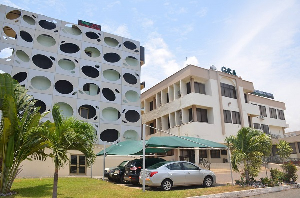 Photo of Ghana Standards Authority headquarters in Accra