The Government of Ghana, the Government of Japan, and the UNICEF have officially launched a landmark US$2.3 million public-private partnership to combat child labour across the country.
This 12-month initiative focuses on strengthening the national child protection framework by leveraging Japanese innovation and private-sector expertise to support over 13,000 vulnerable children and caregivers.
With an estimated 1.1 million children currently engaged in child labour in Ghana, the partnership seeks to address a critical funding gap in the child protection sector.
The project will target five key regions; Ashanti, Eastern, Western North, Ahafo, and Central, aiming to strengthen safeguarding systems, particularly in agriculture, fisheries, and illegal mining communities.
By integrating digital transformation, the initiative will upgrade Ghana’s Child Labour Monitoring System to ensure seamless data sharing between the Ministry of Labour, Jobs and Employment, the Ministry of Gender, Children and Social Protection, and private sector partners.
The partnership also advances the Women, Peace, and Security agenda by empowering adolescent girls and enhancing women’s participation in decision-making.
In addition, it promotes “Green Transformation” by supporting sustainable practices in rural communities.
Through this collaboration, Japan and Ghana are expanding the Child Labour Free Zone initiative as a proof of concept for ethical sourcing, ensuring that Ghana’s primary exports meet international human rights due diligence standards.
Japan’s Ambassador to Ghana, Hiroshi Yoshimoto, underscored the importance of the initiative.
"Japan is committed to fostering a global industrial ecosystem where economic growth and human rights go hand in hand," he said. "Through this investment, we are bringing Japanese innovation and private-sector expertise to the forefront of Ghana’s mission to end child labour. By strengthening human rights due diligence and promoting ‘Green Transformation’ in agriculture and mining communities, we are ensuring that the bonds of trade between our two nations are built on a foundation of dignity and shared prosperity."
The UNICEF Representative in Ghana, Osama Makkawi Khogali, highlighted the broader impact of the intervention.
"Everything is connected: a child’s protection, their education, and their family’s economic resilience," he said.
"This partnership is transformative because it addresses the root causes of child labour through a multi-sectoral lens. By integrating digital technology to make vulnerable children ‘visible’ to social services, we are strengthening the systems that keep families together. Investing in the protection of Ghana’s children is the smartest investment we can make for the country’s long-term development."
Regional News of Friday, 27 March 2026
Source: UNICEF Ghana
Ghana, Japan and UNICEF launch US$2.3m partnership to combat child labour
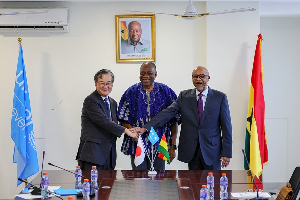 This 12-month initiative focuses on strengthening the national child protection framework