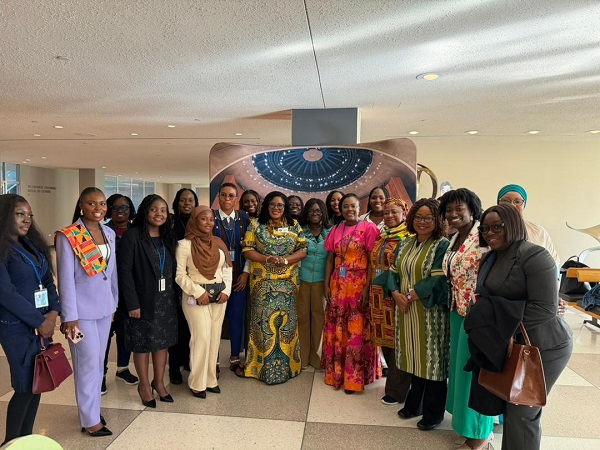
Ghana’s Minister for Gender, Children and Social Protection, Dr Agnes Naa Momo Lartey, has met with young women and civil society representatives on the sidelines of the 70th session of the United Nations Commission on the Status of Women (CSW70) in New York to discuss efforts to advance gender equality and address emerging challenges affecting women and girls.
The engagement formed part of the minister’s activities on the opening day of the conference and brought together participants from various gender advocacy groups, civil society organisations and non-governmental organisations attending the global meeting.
In her opening remarks, Dr Momo Lartey commended the participants for their commitment to promoting gender equality and improving the wellbeing of women and girls.
She noted that the Ministry of Gender, Children and Social Protection is working to reduce vulnerability in society as part of the Reset Agenda of John Dramani Mahama.
According to her, the ministry has made progress in advancing reforms and policies aimed at strengthening protection and empowerment for women and vulnerable groups.
“The Ministry has made significant progress in advancing key reforms and policies, including the passage of the Affirmative Action (Gender Equity) Act, the Social Protection Act, and the launch of the National Gender Policy,” she said.
During the interaction, participants raised concerns about emerging gender issues, including digital violence against women, the online sexualisation of girls and body shaming on social media platforms.
Responding to the concerns, the minister explained that digital violence and online abuse are addressed under Ghana’s Cybersecurity Act and encouraged victims to report such incidents to the police.
“Digital violence and online abuse are addressed under Ghana’s Cybersecurity Act, and victims are encouraged to report such incidents to the nearest police station with screenshots or other digital evidence to support investigations,” she said.
Dr Momo Lartey also acknowledged that Ghana does not yet have specific legislation addressing body shaming but noted that victims can seek support through the ministry.
“Although Ghana does not yet have specific legislation that directly addresses body shaming, individuals experiencing such abuse can seek support through the Ministry, which provides psychological and emotional assistance through its gender support services,” she added.
She further used the opportunity to outline the ministry’s ongoing advocacy and policy interventions implemented over the past year and a half under President Mahama’s leadership, emphasising the government’s commitment to strengthening systems that protect women and girls.
In her closing remarks, the minister encouraged young women to remain determined in their advocacy for gender equality.
She urged them to remain “confident, resilient, and steadfast in their advocacy” and not allow societal barriers to limit their aspirations.
The engagement forms part of Ghana’s participation in CSW70, where the minister is expected to continue interacting with civil society groups, development partners and global stakeholders to strengthen collaboration in advancing gender equality and women’s empowerment.
Regional News of Tuesday, 10 March 2026
Source: www.ghanaweb.com
Gender Minister engages civil society, young women at UN Women's Conference
 The engagement formed part of the minister's activities on the opening day of the conference







Opinions