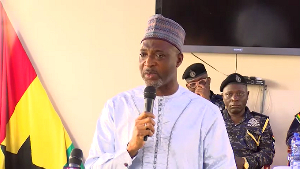
The Chief Executive Officer of Chamber of Oil Marketing Companies, Ghana (COMAC), Dr Riverson Oppong, has rejected government’s claims over recent fuel price reductions, arguing that the drop in prices is not the result of any direct state intervention but rather sacrifices made by players within the industry.
Speaking on Joy News' PM Express on Wednesday, April 15, 2026, he stressed that the reductions at the pumps have not been driven by any cuts in taxes or levies.
His comments follow suggestions from the presidency that the government is cushioning consumers against rising global oil prices, particularly amid tensions in the Middle East.
According to Oppong, while the price drop is evident, the source of the relief tells a different story.
“The relief of GH¢0.36 on petrol and GH¢2 on diesel is true, but let me also highlight the fact that this is a relief that stems from operational margins of activities of the industry, and it has not touched the government as it did not touch any tax or levies that go into the government coffers,” he said.
He cautioned that the current approach places additional financial strain on key institutions and private operators within the sector.
“But this also means that NPA and even BOST would have to cough up external money to support this. So for me, the question here is whether this is a relief or pressure on institutions?”
While admitting that consumers will benefit from the lower prices, he maintained that the burden has simply been shifted elsewhere.
March PPI rises marginally to 1.5%
“I believe that the ordinary Ghanaian will be happy. We are also happy because we buy fuel. But I think the term that we are giving it needs to be considered where there is no touch on tax.”
Dr Oppong further pointed to the pressure on oil marketing companies, especially in relation to discounted diesel, explaining that firms are forced to finance operations upfront while waiting for reimbursement.
“Discounted diesel especially means that oil marketing companies will have to pre-finance the purchase and retailing of the product before government pays us after roughly one and a half months,” he said.
He revealed that the matter has already been taken up with the regulator, calling for quicker payments to ease liquidity challenges.
“In today’s meeting with NPA, we made NPA aware that these are working capital of the industry, and therefore we want payment as fast as possible,” the COMAC CEO said.
“Assuming that one person lifts 10 million litres a month, that means that the person is in debt of GH¢603,000, which is more than half a million cedis that could have purchased fuel for retailing,” he explained.
He added that industry players are now seeking some relief from the tax authorities to help manage the pressure.
“On the other hand, we are also going to negotiate with GRA since no tax was touched, we want to plead with GRA to also delay tax payments from our members or the industry, that’s the LPG and oil marketing companies, and that also brings some buffer onto what we are doing.”
He argued that the downstream sector is consistently made to absorb the impact of policy decisions.
“It is just unfortunate. Let me put it very unapologetically here. It’s just unfortunate that the downstream business is always receiving the burden for the government; we are the ones always coming to solve problems for the government,” he stated.
SO/SA
Business News of Thursday, 16 April 2026
Source: www.ghanaweb.com
Fuel 'relief' not from government - COMAC CEO
 Dr Riverson Oppong is the Chief Executive Officer of COMAC