In a bid to extend the reach of government youth initiatives, David Walter Hormenu, former NDC Constituency chairman for Lower Manya Krobo in the Eastern Region through the Walter Hormenu Foundation (WHF), has provided sewing machines and hair dryers to support 100 apprentices and 20 trainers in Lower Manya Krobo.
The gesture comes in the context of the NDC-government’s flagship National Apprenticeship Programme (NAP) and Adwumawura entrepreneurship scheme — both designed to address youth unemployment and boost self-employment.

Addressing the beneficiaries, Walter Hormenu, former NDC constituency chairman for Lower Manya Krobo, explained that although many young people registered under NAP — which offers free technical and vocational training, certification, and startup support — not all can be absorbed immediately. The Foundation’s intervention is meant to “complement” the government scheme by equipping trainees with essential tools and ensuring they do not miss out.
Under NAP, training combines classroom instruction (30%) with hands-on workplace learning (70%) under qualified master-craft persons or certified trainers.
Successful apprentices receive certification, start-up tools, and support to begin their own businesses.
Furthermore, the Adwumawura Programme aims to support some 10,000 young entrepreneurs aged 18–35 annually, providing mentorship, start-up capital, and business development services.
According to Hormenu, seamstress apprentices will take home the sewing machines after training to launch their own ventures. Hairdressing trainees will get hair dryers upon graduation, while their trainers will use the ones provided initially for training. He added the Foundation plans to offer follow-up support — potentially helping beneficiaries establish themselves in business rather than resorting to other ventures such as informal street-level trading.
“We realised many of you want to work but lack the resources or a helping hand. Our government’s programmes are underway, but until everyone is absorbed, we cannot wait,” Hormenu said.
He described the WHF as an NGO established in honor of his late father, who had helped many in society. The foundation aims to fill gaps where official programmes have yet to reach, especially among vulnerable youth, orphans, and those from underserved communities.
One trainer, Bantey Charity, expressed gratitude, stating that the equipment will significantly improve training capacity. “I have eight apprentices — this support will help us train them properly,” she said.
A beneficiary, Catherine Teye, also thanked the Foundation, saying the sewing machine will greatly aid her training since “we don’t have enough.”
The WHF’s intervention highlights how public-private collaboration — combining large-scale government initiatives with targeted community support — can help ensure that youth employment and empowerment programmes reach those who could otherwise be left behind.
As implementation of NAP and Adwumawura unfolds nationally — backed by over GH¢410 million in 2025 allocations — such complementary actions may prove critical to achieving government’s promise of creating a generation of self-reliant artisans, entrepreneurs, and skilled workers.
Regional News of Tuesday, 9 December 2025
Source: Michael Oberteye, Contributor
Former NDC Chairman donates tools to 100 apprentices, 20 trainers
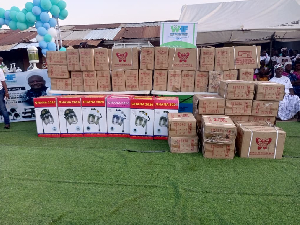 The items donated by the former NDC chairman through his foundation




Entertainment

Singer Chichi survives ghastly Car accident in US

Opinions