Ghana’s acquisition of a new presidential aircraft has reignited public debate over government spending priorities, the cost of maintaining the country’s aviation fleet and the political positions previously taken by members of the governing National Democratic Congress (NDC) on the purchase of presidential jets.
The controversy followed the arrival of a new Dassault Falcon 6X aircraft in Accra on November 16, 2026, after Parliament approved a US$60.68 million purchase agreement with French aerospace manufacturer Dassault Aviation in December 2025.
The acquisition has attracted criticism from sections of the public and opposition politicians, who have questioned the timing and necessity of spending millions of dollars on a presidential aircraft amid concerns about the cost of living and other economic challenges.
The debate has also revived questions about the NDC's earlier opposition to the acquisition of presidential jets when it was in opposition, particularly its criticism of the previous New Patriotic Party (NPP) administration's aircraft procurement plans.
The government, however, maintains that the purchase was necessary because the existing Falcon 900EX, which has served as Ghana's presidential aircraft since 2010, had developed recurring technical problems and become increasingly expensive to maintain.
Government Communications Minister Felix Kwakye Ofosu has said the new aircraft has a longer operational range, allowing it to undertake longer international journeys with fewer refuelling stops.
But beyond the political controversy, how does the newly acquired Falcon 6X compare with the Falcon 900EX it is expected to replace in terms of purchase price, performance, mileage, passenger capacity and other specifications?
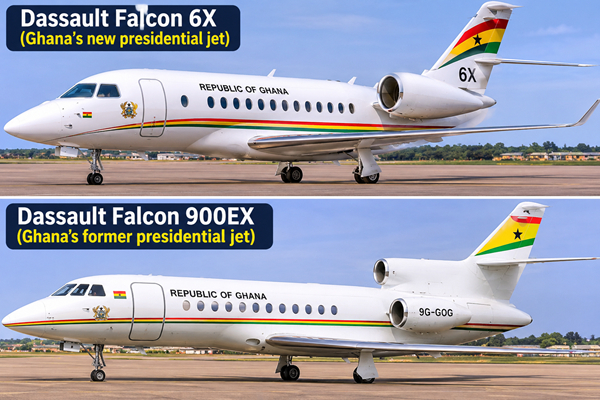
This article examines the two aircraft.
1. Purchase cost:
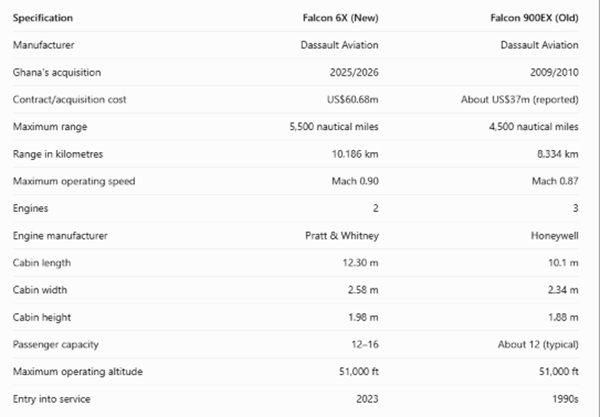
The Falcon 6X was acquired under a US$60.68 million contract approved by Parliament on December 4, 2025.
The agreement was between the Government of Ghana, represented by the Ministry of Defence, and Dassault Aviation of France.
The previous Falcon 900EX was acquired during the administration of former President John Agyekum Kufuor and entered Ghana's presidential fleet in 2010. Reports on its acquisition have put its cost at approximately US$37 million.
The two figures, however, should be treated with caution when making a direct price comparison, as they relate to different procurement periods and may reflect different contractual arrangements.
The Falcon 900EX is also an older aircraft model, with pre-owned examples now available on the international market at considerably lower prices than a brand-new Falcon 6X.
Industry listings put the current asking prices of used Falcon 900EX aircraft at approximately US$8.5 million to US$11.25 million, depending on their age, condition, maintenance history and configuration.
2. Mileage and flying range: Falcon 6X travels farther
One of the major differences between the two aircraft is their flying range, which determines how far they can travel without stopping to refuel.
The Falcon 6X has a maximum range of approximately 5,500 nautical miles (10,186 kilometres), compared with the Falcon 900EX's 4,500 nautical miles (8,334 kilometres).
This means the new aircraft has an additional range of about 1,000 nautical miles (1,852 kilometres), representing an increase of approximately 22 per cent.
The difference is significant for long-distance presidential and official international journeys, as the new aircraft can cover longer distances without requiring a refuelling stop.
According to Dassault Aviation, the Falcon 6X can fly a range of 5,500 nautical miles at Mach 0.80, with eight passengers and three crew members under specified flight conditions.
The Falcon 900EX, meanwhile, was designed for long-range business and executive travel, with a maximum range of about 4,500 nautical miles.
The increased range of the Falcon 6X is one of the key reasons the government has cited in defending its acquisition.
3. Speed and flight performance
Both aircraft are designed for long-distance, high-speed executive travel, but the Falcon 6X has a higher maximum operating speed.
The Falcon 6X has a maximum operating speed of Mach 0.90, while the Falcon 900EX has a maximum cruise speed of approximately 482 knots, equivalent to about 893 kilometres per hour.
The Falcon 6X can also cruise at Mach 0.85 over distances of up to 5,100 nautical miles under the manufacturer's specified conditions.
Although the maximum operating Mach number is not the same as the normal cruising speed, the figures demonstrate the performance capabilities of the newer aircraft.
Both aircraft can operate at altitudes of up to 51,000 feet, allowing them to fly above much of the commercial air traffic and weather disturbances encountered at lower altitudes.
4. Engine capacity: Two engines versus three:
Another major distinction between the Falcon 6X and Falcon 900EX is their engine configuration.
The Falcon 6X is powered by two Pratt & Whitney Canada PW812D engines, each producing approximately 13,500 pounds of thrust.
The Falcon 900EX, on the other hand, uses three Honeywell TFE731-60 engines, each producing approximately 5,000 pounds of thrust.
The Falcon 900EX's three-engine configuration was part of its original design, while the Falcon 6X adopts a twin-engine configuration with newer-generation powerplants.
The newer engines are designed to improve fuel efficiency and reduce emissions. Dassault Aviation also says the Falcon 6X incorporates advanced systems to monitor aircraft maintenance requirements.
However, having two engines instead of three does not, by itself, establish that the new aircraft will be cheaper to operate. Actual operating costs depend on fuel consumption, maintenance, utilisation, crew requirements and other factors.
5. Cabin space and passenger capacity
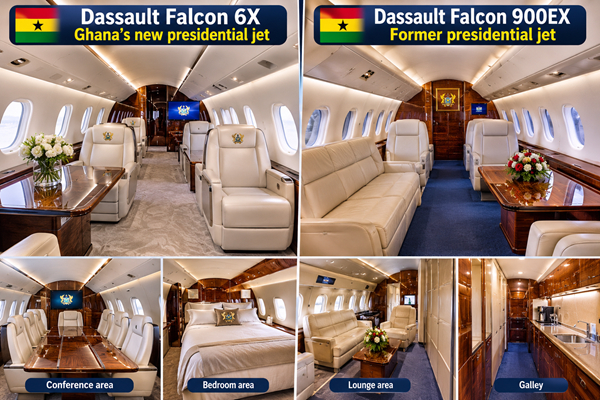
The Falcon 6X offers a significantly larger cabin than the Falcon 900EX, providing more space for passengers and facilities during long-distance journeys.
According to the manufacturer's specifications, the Falcon 6X has a cabin measuring 12.30 metres in length, 2.58 metres in width and 1.98 metres in height.
The Falcon 900EX, in comparison, has a cabin measuring approximately 10.1 metres in length, 2.34 metres in width and 1.88 metres in height.
This gives the Falcon 6X a longer, wider and taller cabin, offering more room for passengers to move around and work during flights.
In terms of passenger capacity, the Falcon 6X can accommodate between 12 and 16 passengers, depending on its configuration.
The Falcon 900EX can also accommodate different passenger numbers depending on its interior arrangement, with typical configurations seating approximately 12 passengers.
The additional cabin space in the Falcon 6X provides greater flexibility for executive meetings, official engagements and other activities during presidential journeys.
6. Technology and onboard facilities
The Falcon 6X comes with more recent aviation technology, including Dassault's EASy IV flight deck, designed to improve flight management and pilot awareness.
It also features the FalconEye combined vision system, which provides pilots with enhanced visibility and situational awareness, particularly when approaching airports in darkness or poor weather conditions.
Another feature is the FalconScan advanced diagnostics system, which monitors and reports on approximately 100,000 maintenance parameters to help identify potential technical problems.
The Falcon 900EX, depending on its configuration and subsequent upgrades, uses earlier-generation avionics systems, including the Honeywell Primus and Dassault's EASy flight deck on later versions.
While the older aircraft can also be equipped with modernised navigation and communication systems, the Falcon 6X benefits from being designed around newer-generation technology.
7. Age and maintenance history
The Falcon 900EX has served as Ghana's presidential aircraft since 2010 and is now approximately 16 years old.
Over the years, the aircraft has experienced technical and maintenance challenges that have affected its availability for presidential travel.
In 2025, it was grounded in France for approximately eight months to undergo extensive maintenance and repairs.
The maintenance exercise reportedly uncovered problems, including corrosion in the aircraft's fuel tanks and a fuel leak, requiring technical support from the manufacturer and the sourcing of certified spare parts.
The aircraft was eventually returned to Ghana and handed over to the Ghana Air Force on November 10, 2025, after completing the necessary inspections and repairs.
The Falcon 6X, in contrast, is a newer-generation aircraft that entered commercial service in November 2023.
Its acquisition is expected to provide Ghana with a more modern aircraft and reduce the maintenance challenges associated with relying on an ageing presidential jet.
8. At a glance: Falcon 6X versus Falcon 900EX
9. What does the acquisition mean for Ghana?
The acquisition of the Falcon 6X represents a major change in Ghana's presidential air transport arrangements, replacing an aircraft that has served the country for more than a decade with a newer model offering greater range, cabin space and updated technology.
However, the purchase has also reopened the political debate over the country's spending priorities and the positions previously taken by the NDC on presidential aircraft.
The Minority in Parliament has called for further explanations regarding the cost and financing arrangements, while the government maintains that the acquisition was necessary to address the operational challenges associated with the ageing Falcon 900EX.
The new aircraft is also part of a broader military aviation retooling programme, which includes the acquisition of four Airbus helicopters under a separate €125.97 million agreement.
Although the Falcon 6X offers improvements in several technical areas, questions remain about its actual operating costs, the long-term maintenance arrangements and the eventual use of the Falcon 900EX.
For now, Ghana has taken delivery of a newer presidential aircraft, but the public debate surrounding the US$60.68 million expenditure is likely to continue.
BAI
“We Like the Design, Release It Now” – Ghanaians React to New Currency Notes
General News of Thursday, 19 November 2026
Source: www.ghanaweb.com
Falcon 6X vs Falcon 900EX: Ghana’s new presidential jet and old version compared
 L-R: The old presidential jet and the new one