46 years ago, Ghana was a nation on the brink of a turmoil. Years of political instability, marked by successive military coups and short-lived civilian governments had left its economy in tatters and its social fabric strained.
The Supreme Military Council (SMC II), led by Lieutenant General Fred Akuffo, had taken power in a palace coup in 1978, promising a return to civilian rule and an end to the widespread corruption and economic mismanagement that plagued the country.
However, conditions only seemed to worsen.
The nation was gripped by severe economic hardships.
Soaring inflation eroded the value of the cedi, leading to a dramatic increase in the cost of living.
Essential commodities, from foodstuffs to basic groceries, became scarce, giving rise to a black market known as "kalabule," where goods were hoarded and sold at exorbitant prices.
The gap between the rich and the poor widened dramatically, with no discernible middle class.
Unemployment was rampant, and even professionals were fleeing the country in search of better opportunities.
Beyond the economic woes, there was a profound sense of disillusionment and frustration among the populace.
Corruption was endemic, permeating every level of society, including the highest ranks of the military government.
This seemingly institutionalised graft bred deep resentment, particularly among the junior ranks of the armed forces who felt the pinch of unpaid salaries and the indignity of a military whose reputation was at an all-time low.
The political atmosphere was charged with social repression and a pervasive sense of injustice.
It was against this backdrop of widespread discontent that Flight Lieutenant Jerry John Rawlings, a junior officer, attempted a coup on May 15, 1979, just weeks before scheduled democratic elections.
Although this initial attempt failed, and the late former President Jerry John Rawlings was arrested and put on public trial, his powerful accusations of corruption against the military regime resonated deeply with the suffering masses.
His defiance and willingness to sacrifice himself for his fellow soldiers turned the trial into a public platform, transforming him into an unlikely folk hero and further fanning the flames of popular anger.
The stage was set for an explosion. The anger of the ordinary Ghanaian, the frustration of the junior military officers, and the revelations from Rawlings' trial coalesced into a powerful, undeniable demand for radical change.
The June 4th Revolution was not merely a coup d'état; it was a popular uprising, a desperate cry for probity, accountability, and social justice in a nation brought to its knees.
Read an article from a publication on GhanaWeb four years ago
Here’s how the state newspaper reported the June 4 revolution
Jerry Rawlings announced on the radio a takeover of the Supreme Military Council II
General Fred Akuffo was ousted from office by the AFRC
Some 42 years ago on June 4, 1979, many Ghanaians woke up to a radio announcement by the late Flight Lt.
Jerry John Rawlings of a change in government by the Armed Forces Revolution Council (AFRC).
Known as the June 4th revolution, the Supreme Military Council II led by General Fred Akuffo was ousted from office by the AFRC.
The reasoning behind what many described as a coup at the time but is now known as a revolution was borne out of a combination of many things gone wrong with the country at the time.
These included; bad governance, corrupt practices, a lack of discipline among the ranks of the army which was said to have frustrated many Ghanaians.
Today in History brings an image of how the state newspaper, Daily Graphic reported the takeover of government by the Rawlings military regime.
The image which was captured on the front page of the newspaper on Tuesday, June 5 1979 read; ‘ACCRA AT STANDSTILL”
The edition number 8901 was filed with an image of the former Ghanaian leader dressed in his full military attire with an associated image of citizens taking to the streets of Accra.
VPO/AE
Meanwhile, catch up on the concluding part of the story of Fort William, where children were sold in exchange for kitchenware, others, below:
General News of Wednesday, 4 June 2025
Source: www.ghanaweb.com
FLASHBACK: Here’s how the state newspaper reported the June 4, 1979, revolution
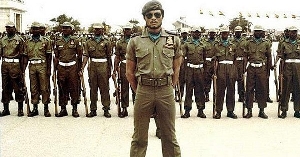 An old picture of the late President Ft Lt Jerry John Rawlings with his squadron