Constitutional Review: Examining Key Provisions of Ghana's 1992 Constitution Under Scrutiny
Amidst increasing calls for a review of Ghana's 1992 Constitution, several key provisions have become the focus of intense public and expert debates.
The John Dramani Mahama-led NDC government has faced mounting pressures to initiate constitutional reforms addressing concerns about the considerable power vested in the executive branch.
Critics argue that this concentration of power renders crucial government sectors vulnerable to undue influence.
In light of this ongoing discussion, GhanaWeb highlights five specific areas of the 1992 Constitution that have consistently emerged in public discourses regarding potential amendments:
1. Scrapping the Council of State
The relevance of the Council of State (CoS) established by Articles 89 to 92 of the 1992 Constitution of Ghana has faced growing scrutiny, becoming a recurring point in proposed constitutional reviews advocated by constitutional experts, jurists, and statesmen.
While some maintain that they play a vital role in Ghana's constitutional framework by advising the president on critical national matters, others contend that it has outlived its usefulness. Some critics even label it a mere rubber stamp for the Executive and an undemocratic institution that should be abolished in a democratic system.
Professor Baffour Agyeman-Duah, a former senior governance advisor at the United Nations, had given his support to scrapping the Council of State, while speaking in a JoyNews report on May 31, 2022.
He argued that the body has lost its relevance in the current national context.
Despite being established as a key institution under the 1992 Constitution to advise the president on significant national issues, its impact and necessity have been questioned, particularly given the country's current economic challenges.
Professor Agyeman-Duah emphasised that the prevailing economic downturn necessitates deliberate measures to curb public spending, even if the constitution mandates the existence of the council.
The Council of State, composed of prominent citizens akin to traditional councils of elders, advises the president on a range of national issues.
2. Executive Power in the appointment of judges to the Supreme Court
Concerns have been raised regarding the extent of the executive's influence in the appointment and potential removal of judges.
Lawyer Augustine Obuor, commenting on attempts to remove the Chief Justice from office, suggested that the president's role in determining a prima facie case, in consultation with the Council of State, effectively makes the Chief Justice's removal a foregone conclusion.
The president ultimately holds the final decision after a committee, also constituted by the executive, hears the defense and provides recommendations.
Augustine Obuor argued that Article 146 of the 1992 Constitution makes it too easy to remove the Chief Justice, highlighting the significant power the executive wields in the process.
3. Appointment of the Inspector General of Police (IGP)
Policy analyst, Emile Francis Short, advocated for a strict limitation of presidential appointments to only ministers and cabinet members.
He argued that the heads of institutions and public officials should be appointed by the respective institutions themselves.
Critics have contended that the current practice stifles democracy and places appointees in a compromising position, potentially hindering their objectivity due to fear of displeasing the incumbent government.
He questioned the necessity of the president's involvement in the appointment of the IGP, suggesting it has little to do with the core functions of running the government.
He proposed that the president should focus on appointing ministers, allowing other institutions to participate in the selection of the IGP.
Currently, Chapter 15, Article 202 (1) of the 1992 Constitution stipulates that the Inspector General of Police is appointed by the President in consultation with the Council of State.
4. Appointment of Members of Parliament (MPs) as Ministers
Fifi Kwetey, the General Secretary of the National Democratic Congress (NDC), is advocating for constitutional reforms to separate parliamentary duties from ministerial appointments.
In a recent interview on Channel One TV on May 6, 2025, Kwetey expressed concern over the increasing trend of individuals seeking parliamentary seats primarily as a means to secure ministerial positions, rather than out of a genuine commitment to legislative service.
Kwetey emphasised that serving the people should be the primary motivation for seeking parliamentary office, not the expectation of a ministerial appointment.
He stressed that ministerial roles should be considered a "bonus," not the main objective.
He insisted that the constitutional review should prioritise decoupling these two roles to ensure the emergence of "genuine parliamentarians" dedicated to their legislative duties.
He further argued that the current system allows political aspirants to mislead voters by contesting parliamentary elections with the underlying intention of joining the executive branch.
5. Establishment of a Second Chamber in Parliament
There is a proposal to establish an upper chamber in Parliament to review final bills that have been debated on the floor.
This upper chamber would ideally be composed of neutral statesmen, traditional leaders, and experienced experts with high moral standing and integrity.
The aim is to provide an additional layer of scrutiny and oversight, acting as a check on the members of the primary legislative body.
6. Ex-Gratia
‘Article 71’ Officeholders under the 4th Republican Constitution of Ghana have been a subject of discussion in Ghana for myriad reasons.
There are some who perceive that Article 71 Officeholders earn too much from the State.
Other critics argue that the ‘end-of-term’ benefits that these officers receive after every 4 years is excessive, without any justification and an abuse of the limited national resources.
It has been publicly reported that Public Officials and other Article 71 Office Holders of successive governments under the 4th Republic have, after their term of office, received huge sums of money as ex-gratia after their 4-year term, regardless of them being ministers or Members of Parliament who have either lost their seats or have been re-elected.
Critics have argued that for a developing country which is struggling to stabilise its economy, ex-gratia is not a prudent provision and have called for it to be scrapped.
VPO/AE
Meanwhile, watch GhanaWeb's tour of Odweanoma Paragliding Field below:
General News of Thursday, 8 May 2025
Source: www.ghanaweb.com
Examining 6 key provisions of Ghana's 1992 Constitution heavily under scrutiny
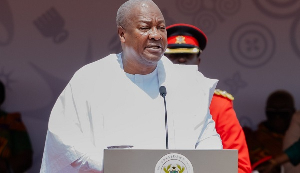 President John Dramani Mahama is Ghana's Head of State