The Ministry of Education has reaffirmed its commitment to strengthening foundational literacy and numeracy and improving learning outcomes, particularly in deprived and underperforming schools across Ghana.
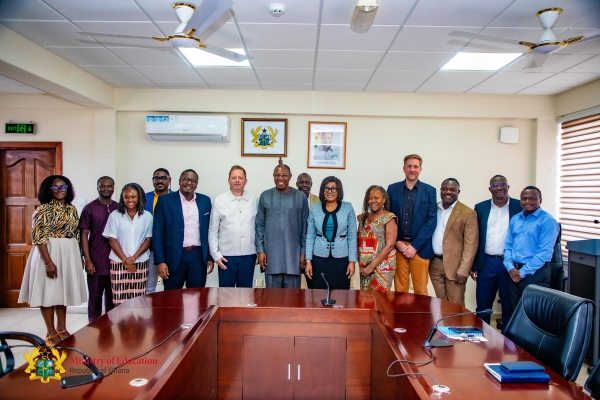
Deputy Minister of Education, Dr Clement Abas Apaak, made the commitment when a delegation from the Jacobs Foundation paid a courtesy call on the Minister of Education in Accra on Tuesday.
Dr Apaak, who received the delegation on behalf of the Minister, commended the Jacobs Foundation for its continued partnership with the Ministry, describing the Foundation as an important partner in Ghana’s efforts to improve education outcomes.
He noted that the Foundation’s support had contributed to Ghana unlocking US$40 million under the Global Partnership for Education (GPE) Multiplier Grant, through the mobilisation of additional resources from development partners, bringing the total funding mobilised to US$80 million.
According to him, the funds were supporting interventions under the Ghana Accountability for Learning Outcomes Project (GALOP), the Communities of Excellence initiative and other programmes aimed at improving learning outcomes, particularly in deprived schools.
Dr Apaak said the Communities of Excellence initiative was already yielding positive results, with some schools outside the GALOP programme beginning to adopt practices from schools participating in GALOP.
He disclosed that 3,608 schools across 129 districts were currently participating in the initiative. The Ministry, he added, had completed the operational manual, trained district focal persons and developed and rolled out a Foundational Learning Leadership Toolkit for beneficiary schools and district teacher support teams.
Strengthening evidence-based decision-making
Touching on the Ghana Education Data and Learning Lab (GIDLab), Dr Apaak said the initiative was designed to strengthen evidence-based decision-making through research, data management and knowledge dissemination.
He said the Ministry had, since January 2026, developed a Research and Learning Agenda and an operational manual to guide the implementation of the initiative.
The Deputy Minister stressed that the ultimate measure of the various interventions would be their impact on learning outcomes, particularly in foundational literacy and numeracy.
He said the Ministry remained committed to accountability and ensuring value for money in the use of resources provided by development partners.
Dr Apaak also raised concerns about the impact of illegal small-scale mining on cocoa-growing communities, noting that some farmers were abandoning their cocoa farms for illegal mining activities.
He warned that the development could have wider implications for communities, including education, and called for continued collaboration to address challenges affecting learning.
For his part, the Chief Executive Officer of the Jacobs Foundation expressed confidence in Ghana as a long-term partner in education development.
He said the relationship between the Foundation and the Ministry was built on transparency, honesty and reliability, noting that the Foundation valued the openness with which both sides discussed challenges rather than focusing only on successes.
The CEO said members of the Foundation’s Board were particularly impressed during visits to schools by the openness of teachers in discussing the challenges they faced.
He said the experience had left the Foundation inspired and more confident that Ghana was the right country in which to pursue its education interventions.
He further disclosed that Ghana’s experience had attracted international interest following a presentation of its joint work with the Foundation at a foundational learning conference in Dakar, Senegal.
According to him, senior representatives of Senegal’s Ministry of Education had expressed interest in learning how Ghana had established its partnership with the Foundation and how similar approaches could be adapted in Senegal.
The CEO said the Foundation was interested in supporting interventions that could move beyond a limited number of schools and communities to achieve broader, country-level impact.
He also pledged the Foundation’s continued support for efforts to coordinate development partners and reduce fragmentation in Ghana’s education sector.
He emphasised that the Ministry of Education must remain at the centre of decision-making and responsibility for the sector, assuring the Ministry of the Foundation’s continued partnership.
“We are with you. I brought my money with me,” he said, underscoring the Foundation’s commitment to supporting Ghana’s education transformation agenda.
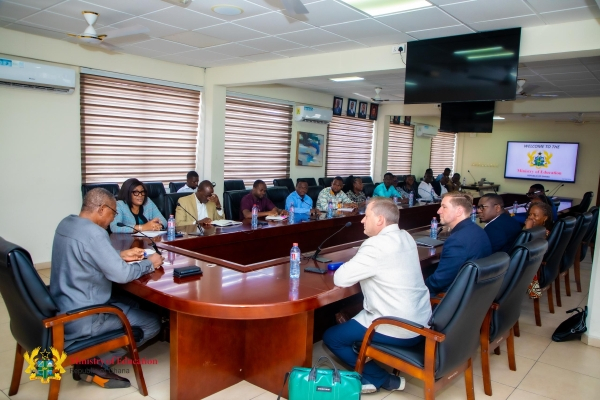
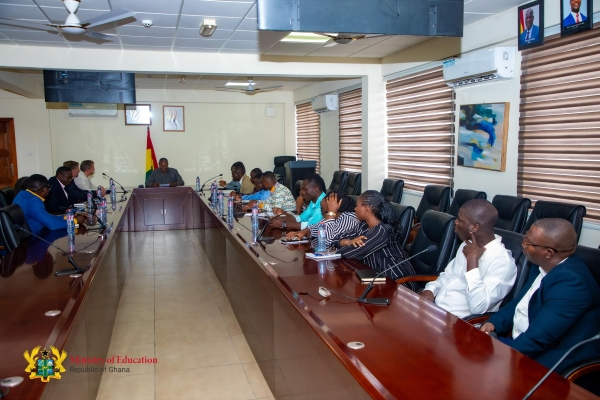
The engagement provided an opportunity for the Ministry and the Jacobs Foundation to review progress under their partnership, discuss emerging challenges and reaffirm their shared commitment to improving foundational learning and education outcomes across Ghana.
General News of Tuesday, 25 August 2026
Source: www.ghanaweb.com
Education Ministry reaffirms commitment to improving foundational learning
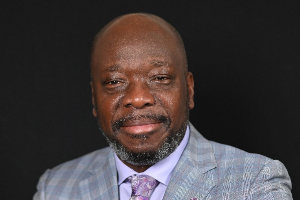
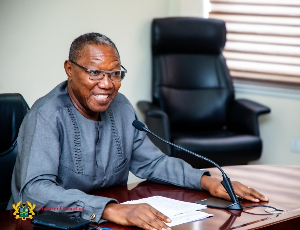 Dr Clement Abas Apaak is the Deputy Minister of Education