President John Dramani Mahama has said he has been reluctant to declare a state of emergency in the fight against illegal mining, also known as galamsey, because existing laws already give the government enough powers to act.
Speaking at a media encounter in Accra on Wednesday, September 10, 2025, he explained that agencies can arrest offenders, seize equipment, and enforce forest protection laws without the need for emergency measures.
The president added that his administration has not issued any license for mining in forest reserves and revealed that steps are underway to repeal LI 2462, the law that permits such activities.
Kwakye Ofosu explains permanent military presence at 44 'galamsey' sites
Despite these assurances, many civil society groups, political leaders, and religious organisations have renewed calls for him to declare a state of emergency to curb the destruction of forests, rivers, and farmlands caused by galamsey.
Convener of the Coalition Against Galamsey, Dr Ken Ashigbey, has stressed that the conditions to declare a state of emergency already exist.
Galamsey: President Mahama hot as bishops pile more pressure>
Speaking on Citi FM on Tuesday, September 16, 2025, Dr Ashigbey recalled that President Mahama himself had previously described galamsey as a national emergency, yet state institutions had been slow to back those words with decisive action.
“We know the president is not one to implement laws in a draconian manner. But under a state of emergency, we can be specific in how we apply the law and what exactly we do,” he explained.
Dr Ashigbey also cited the destruction of water bodies as a compelling justification for such a declaration.
“Currently, if you take all our water bodies, there is no fishing taking place in them. But the ‘chamfans’ are still on them. In many places, people have blocked portions of rivers and are mining illegally. You can declare a state of emergency in those areas,” he said.
He further pointed to forest reserves, which, despite some reclamation efforts, continue to suffer widespread devastation.
But what does a state of emergency in areas affected by illegal mining mean?
The declaration of a state of emergency is enshrined in Article 31 of the 1992 Constitution.
It gives the president power to declare a state of emergency when the life of the nation is under threat, be it from war, natural disaster, or any calamity that makes normal governance impossible.
If declared, Parliament must approve it within 72 hours, and it can last up to 12 months.
During this period, the government gains extraordinary powers to restrict movements, seize properties, and issue emergency laws.
In the context of galamsey, a state of emergency could mean the deployment of soldiers and police to flush out illegal miners, destruction of excavators, and the securing of polluted water bodies.
Why it may help
Declaring a state of emergency in galamsey-affected areas could bring immediate protection for water bodies and forests.
The presence of the military and police would serve as a deterrent, scaring off illegal miners.
It would also allow for rapid enforcement of bans and regulations without being slowed by bureaucratic bottlenecks.
Such a declaration would reassure the public that the government is willing to take drastic steps to secure natural resources for future generations.
JKB/AE
I was shot at and nearly killed – Dr Yaw Osei Adutwum recounts escaping death in the line of duty
General News of Thursday, 18 September 2025
Source: www.ghanaweb.com
EXPLAINER: How a state of emergency could impact the galamsey fight
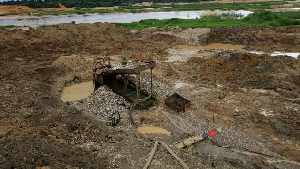 Galamsey in Ghana has become a national canker



Entertainment