General News of Tuesday, 31 March 2026
Source: www.ghanaweb.com
Dutch institution contacts Ghana over artefacts – Spio-Garbrah reveals

Presidential Special Envoy for Reparations, Ekwow Spio-Garbrah, has disclosed that his office has received communication from a Dutch institution regarding the possible return of artefacts taken from Ghana.
According to him, the correspondence signals growing international willingness to engage Ghana on restitution and reparations following Ghana’s UN resolution on slavery.
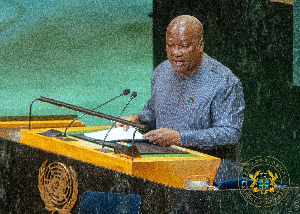
President Mahama Returns from UN General Assembly as Ghana Secures Landmark Resolution
Speaking on JoyNews on Tuesday, March 31, 2026, Spio-Garbrah revealed that his office had been contacted by a Dutch entity with a catalogue of Ghanaian artefacts in their possession.
“… So already, my office has received correspondence from a Dutch company, a Dutch museum, which says, ‘look, there's a booklet, a whole nice booklet that they have printed themselves of artifacts that are principally from Ghana.
“1,300 different artifacts, which involved wooden products and gold ornaments and kente cloth and other kinds of materials, which they say, look, we are happy to discuss with you; what we should do with these things.’ So there's a lot of work to be done by what is now my small office,” he disclosed.
He further explained that beyond the return of artefacts, Ghana’s reparations agenda would require a structured and multi-faceted approach.
“… But then my office has to plan a series of actions and activities to break down the resolution into its integral parts and so forgiveness, for example, acknowledgement for my president is very important. People must acknowledge their sins,” he explained.
Spio-Garbrah, while touching on the history behind the reparation discussions, pointed to the role played by various European countries in Ghana’s past.
“If you come to Ghana, for example, our reparations agenda has to be multi-dimensional, because we had Portuguese, Don Diego D’ Azambuja and others who came first to Elmina, and then Vasco da Gama and others who also followed later,” he stated.
He went on to highlight the role of other colonial powers and the lasting structures they left along Ghana’s coast, describing them as ‘evidence’ of what had happened.
“Then we had Dutch, Danes, and we had English. So, if you see the forts and castles, over 30 forts and castles dotted around our coastline, which makes Ghana the country that has the greatest evidence, physical evidence, of what happened. You see that there are many countries we have to deal with, many languages that we have to deal with, and many issues we have to deal with,” he indicated.
'We voted against Ghana's slavery resolution with regret' - Israel on UN vote
Ekwow Spio-Garbrah stressed that the reparations effort is more than just symbolic and involves the actual return of stolen heritage.
“And so it's multi-dimensional, multi-sectoral, and again, many of our colleagues say that the crime was committed in the past over a 300-year period, but we're interested in both restitution and reparation, which includes returning artifacts and things that were stolen from Africa, Ghana inclusive,” he stated.
MAG/VPO
Dr Nyaho Nyaho-Tamakloe on Ghana's past, present and the road ahead