The Institute of Economic Affairs (IEA) has urged government to stop renewing expiring mining leases and instead adopt a new mining policy anchored in state ownership of mineral resources, with private firms engaged strictly through service contracts.
Ghana’s former Chief Justice, Sophia Akuffo, stating the institute’s position at a press briefing in Accra argued that the country’s impendings wave of expiring mining leases presents a rare opportunity to restructure the sector without breaching existing contractual obligations.
She stressed that the nation must abandon its long-standing royalty-based mining framework, which she describes as a colonial-era model that delivers only marginal returns to the country despite its vast mineral endowment.
In its place, she is proposing a system in which the state retains full ownership of mineral resources while contracting local and foreign firms to provide technical and operational services.
The intervention comes amid growing concern within the institute over proposals from the Ministry of Lands and Natural Resources to maintain and expand a sliding-scale royalty regime.
IEA said draft Minerals and Mining (Royalty) Regulations, 2025, currently before parliament preserve the existing royalty structure, albeit with adjustments that still fail to address fundamental questions of ownership and value capture.
Under the draft regulations, royalty rates of 5 to 12 percent are proposed for gold and lithium while minerals such as bauxite, manganese, salt, limestone and iron ore attract royalties of about 5 percent.
Akuffo said the institute finds the ministry’s position troubling, particularly reports that a draft bill is under consideration to introduce a 9 to 12 percent sliding-scale royalty regime across the mining sector.
She said this approach stands in sharp contrast to repeated public statements by President John Mahama calling for greater sovereignty over the country’s natural resources.
The institute recalled that the president has openly agreed with calls to review extractive industry agreements which date back to what he described as the “Guggisberg era” and has emphasised the need for increased indigenous participation and higher national returns from mineral exploitation.
BoG to end financing of GoldBod under new gold policy – Dr Kwakye.
While the president, according to IEA, has clearly signalled a commitment to reform, it said the Lands and Natural Resources Minister, Emmanuel Armah-Kofi Buah, continues to promote what it termed an outdated, colonial royalty-based paradigm – creating policy inconsistency at the highest levels of government.
“The president is ahead of his ministers,” Akuffo said, adding that the ministry’s stance reflects a broader national dilemma of being trapped in an old mindset which prioritises royalties over ownership and long-term value creation.
Furthermore, IEA argued that national ownership and effective management of the country’s mineral resources will generate financial, economic and security dividends far beyond any royalty percentage currently under discussion.
Ownership, the institute said, will enable value addition, boost foreign exchange inflows, support industrialisation and create secondary benefits such as jobs, technology transfer and community development.
The institute grounded its position in constitutional and international law, noting that the nation’s natural resources are sovereign assets held in trust for the people under the 1992 Constitution.
It also cited international instruments affirming permanent sovereignty over natural resources, insisting that no foreign entity should derive greater benefit from Ghana’s minerals than the nation itself.
Rejecting arguments that the nation lacks capacity to manage its resources, Akuffo said it has a deep pool of experienced mining professionals – many of whom already manage large-scale operations.
She pointed to Ghanaian-owned firms such as Engineers and Planners, Rocksure International and BCM Ghana Limited, which are actively involved in mining activities across the country.
She added that technology is not an inherent advantage exclusive to foreign firms, noting that it can be purchased, leased or acquired through partnerships.
The country’s mineral resources themselves, she said, can also serve as viable collateral for financing; a strategy already used in projects such as the Ewoyaa lithium development.
IEA moreover described the country’s current royalty regime as inequitable and short-sighted, arguing that it captures only a fraction of national mineral wealth’s true value.
By comparison, the institute cited countries that have secured dominant shares of resource rents for their citizens through stronger fiscal and ownership frameworks.
Norway, for instance, combines state participation with ring-fenced taxation and production-sharing arrangements – enabling it to build one of the world’s largest sovereign wealth funds, now valued at about US$2trillion.
Australia, meanwhile, imposes a 30 percent tax on super-normal mining profits in addition to standard corporate taxes.
Despite its vast mineral wealth, the country has had to seek assistance from the International Monetary Fund 17 times, a situation IEA described as unacceptable and indicative of deep structural flaws in the country’s resource governance model.
Understanding Ghana's stock market and how to invest | BizTech
Business News of Wednesday, 4 February 2026
Source: thebftonline.com
Don't renew expiring mining leases – IEA tells government
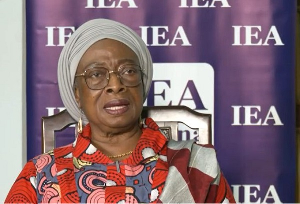 Sophia Akuffo is Ghana’s former Chief Justice