Government’s falling domestic borrowing costs are opening a more favourable financing window to build a GH¢33 billion buffer ahead of a sharp increase in debt repayments in 2027, when domestic DDEP debt service is projected to rise by about 164 percent.
Treasury bill rates have continued their downward trend, with the latest auction pushing the 91-day interest rate below 5 percent to 4.9460 percent, while the 182-day rate declined to 6.8587 percent and the 364-day rate fell to 10.7778 percent.
The decline strengthens government’s domestic financing position as it prepares for one of the heaviest repayment periods under the Domestic Debt Exchange Programme (DDEP).
Government’s debt repayment schedule puts domestic DDEP debt service at about GH¢21.78 billion in 2026, rising to approximately GH¢57.56 billion in 2027 before remaining elevated at GH¢52.52 billion in 2028.
The 2027 requirement is therefore about GH¢35.8 billion higher than this year’s, representing an increase of roughly 164 percent.
A substantial part of next year’s requirement relates to principal repayments. Government’s debt management projections put 2027 domestic DDEP principal maturities at about GH¢39.6 billion, with another GH¢18 billion expected in interest payments.
Treasury is seeking to build funding ahead of those maturities rather than face the full financing requirement when the securities fall due.
The 2026 Annual Borrowing Plan provides for GH¢16 billion, equivalent to seven percent of projected non-oil tax revenue, to be transferred into the Sinking Fund, alongside another GH¢17 billion to be mobilized through domestic bond issuances.
Together, the two measures are expected to provide GH¢33 billion towards the 2027 DDEP principal repayments. The interest component is expected to be provided separately through the 2027 budget.
The GH¢16 billion Sinking Fund allocation will come from fiscal resources, while the GH¢17 billion financing component is expected to be raised through domestic bonds.
Falling T-bill rates therefore do not directly finance the entire GH¢33 billion buffer, but they point to the sharp improvement in domestic financing conditions as government returns to longer-term borrowing.
In December 2024, the 91-day Treasury bill yielded 28.04 percent, while the 182-day and 364-day instruments stood at 28.68 percent and 30.07 percent respectively.
By October 2025, the rates had declined to 10.67 percent, 12.47 percent and 12.88 percent before falling further this year.
The latest 91-day rate of 4.95 percent is now about 23 percentage points below its December 2024 level.
The one-year rate has fallen by more than 19 percentage points over the same period, from 30.07 percent to 10.78 percent.
Investor demand has remained strong even as the rates paid by government have declined.
At the latest auction, bids reached GH¢12.35 billion against government’s GH¢5.15 billion target, providing Treasury with enough demand to reject higher-rate offers while still raising more than initially planned.
The improvement in domestic financing conditions is particularly important as Treasury moves beyond short-term borrowing and rebuilds the longer end of the government securities market.
Restrictions on new medium- and long-term domestic bond issuance imposed after the DDEP expired earlier this year, clearing the way for government to return to longer-dated securities.
The return to the bond market gives Treasury an opportunity to raise part of the GH¢17 billion required for the 2027 buffer without concentrating additional borrowing in Treasury bills that mature every three, six or 12 months.
Longer maturities would also spread future repayment obligations and reduce the amount of debt government has to refinance frequently.
The need to lengthen maturities has become more important because the DDEP created large concentrations of repayments in 2027 and 2028.
Government must therefore manage two financing requirements simultaneously: meeting current budget and refinancing needs while accumulating enough resources to prevent the 2027 maturities from creating another large funding requirement within a relatively short period.
The Sinking Fund is intended to address part of that pressure by setting aside resources before the debt falls due.
The planned GH¢16 billion transfer would cover about 40 percent of the approximately GH¢39.6 billion DDEP principal scheduled for 2027. Adding the GH¢17 billion expected from domestic bond issuance would raise the planned buffer to about 83 percent of the principal requirement.
The remaining principal requirement would be substantially smaller if the full GH¢33 billion is assembled as planned.
Government has already paid GH¢41.36 billion to DDEP bondholders since 2025, including the latest GH¢10.82 billion coupon payment made in August.
The repayment burden will become heavier next year as more principal begins to mature alongside interest payments.
External debt service will add to the financing requirement.
Ghana is expected to face approximately US$2.5 billion in external debt service in 2027, followed by another US$2.4 billion in 2028, putting additional pressure on government cash flows during the same period that domestic DDEP repayments remain elevated.Building the domestic buffer during 2026 would therefore reduce the amount Treasury has to mobilize when both domestic and external repayment obligations increase next year.
The fall in domestic rates provides a better environment for the borrowing side of that strategy.
Government can raise longer-term funds at a point when short-term rates have dropped sharply, investor demand for government securities remains strong and access to the domestic bond market has been restored.
The latest auction reinforces that improvement rather than forming the centre of the story. The 91-day rate has now broken below 5 percent and the one-year rate has fallen to 10.78 percent, extending the reduction in government’s cost of domestic funding.
Government’s ability to take advantage of those conditions over the remaining months of 2026 will determine how much of the GH¢33 billion buffer is in place before DDEP debt service rises from about GH¢21.78 billion this year to nearly GH¢58 billion in 2027.
Business News of Thursday, 3 September 2026
Source: economytimesnews.com
Cheap borrowing costs ease 2027 debt pressure
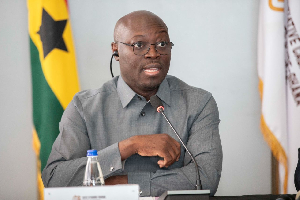 Cassiel Ato Forson is the Minister of Finance