Call them the rejected forty-two or better still, the unidentified 42, and you will not be far from the truth.
That could be the best description of the 42 inmates of the Central Destitute Infirmary, one of Ghana’s oldest elder care homes built by Ghana’s First President, Dr. Kwame Nkrumah, at Asante Bekwai in the Ashanti Region.
Even though mandatory, none of the inmates has a national identification card and no resources have been deployed to help them register to enjoy their rights to be properly identified by any civil registration exercise in the country.
Since 2019, the National Identification Authority, Ghana’s authorised body mandated to offer unique biometrics-backed identification numbers and identity cards to citizens and permanent foreign residents, has registered more than 17 million individuals in Ghana.
Mobile registrations were rolled out to offer institution-based registrations on request, for a fee.
District offices of the National Identification Authority have since taken over continuous registration. Additional provisions have been made for the registration of children aged 6 to 14, with plans afoot offering unique identification codes to babies at birth.
Like many other national interventions, the tale of exclusion, especially for persons with disabilities, unfortunately, continues as inmates of elderly care homes and rehabilitation centres, especially those suffering mental health challenges, appear to have been completely ignored.
Speaking to Ultimate News, the social welfare director in charge of operations for the Central Destitute Infirmary, Bernard Ofori, expressed worry that apart from the facility not having a vehicle to transport inmates to registration sites, stigma has compelled commercial drivers in Bekwai to avoid picking them to avert what they believe will be a bad omen.
“None of our inmates here is having a Ghana card. It’s an issue because most of them are on medications and are sound enough even to vote. No one came here to register us for Ghana cards and even during COVID; no one came here to vaccinate our inmates. When you are here, it’s as if you are not part of Ghana but it shouldn’t be so.
“We have patients with mental health issues and physical challenges. Here in Bekwai, commercial drivers don’t want to pick them in their cars because they think if people see them in their cars they will not patronize their services. There is a big stigma about their conditions. Meanwhile, we don’t also have any source of transportation,” he explained.
The 42 persons at the Central Destitute Infirmary have marked vulnerabilities and disabilities, with a good number of them above 60 years.
Social welfare regulations will not allow a media interview with the inmates unless, under the strict supervision of an officer, a responsibility Bernard Ofori gladly agreed to assist with.
His first call was Albert Moni, an elderly citizen who looks to be in his late sixties.
Albert, mentally sound and still strong, has been living in the home for the past thirty years.
“Have you heard of the Ghana Card? Do you know what it is for?” Bernard asked.
All of Albert’s answers were no, revealing the extent to which the home was neglected in the education, sensitization, and registration process.
Kojo Ntiamoah, another inmate, is much younger. An able man in his thirties, he is physically challenged and unable to walk.
He told Bernard, “I know that the Ghana card is so important, you cannot even register a SIM card without it.
“I would really wish to have one, but I cannot walk. I will register it if they come here to register us,” he added.
Opanyini Bobotey, an elderly man in his fifties, is hard of hearing. Even after screaming the questions, he could hardly get what the social welfare officer was asking.
Benjamin, however, had me know that regardless of his hearing impairment, Bobotey is sound and could be easily assisted in providing information for a National Identity Card.
Another person, Benjamin Obeng, mentally challenged, veered into entirely contrasting issues soon after starting off on a good note;
“I’ve not been in Ghana for too long. I have my passport and driver’s license. I hear Ghana is celebrating its anniversary. The Ghana card can be used to clean the airports and harbours for me,” he went on incoherently.
Cheshire Rehabilitation Home
The National Identification Authority Act, 2006 (Act 707), the law that mandates the NIA, stresses among others, the registration of all citizens, permanent residents, and dual citizens with proven documents.
The neglect of care facilities in the Ghana Card Registration, which flies in the face of the vision, mission, and law that established the National Identification Authority, is the same at the Cheshire Home, which houses twenty-seven inmates undergoing mental health rehabilitation.
The Mental Health Officer at the facility, Harriet Osei Owusu, pointed out that the home caters for substance users, schizophrenic patients, manic and depressive patients.
Mrs. Osei Owusu recounted incidents where patients were unable to link their National Health Insurance Cards to the Ghana Cards because they did not have one.
She advocated that the state make separate arrangements to register such patients in their facilities where qualified staff are on hand to offer the needed assistance.
“Next time when they are doing such exercises, they should come here and the workers will assist them. Persons with mental disabilities without medications are different from those here taking medications.”
“Those here are sound and will answer any question you ask them. They don’t need any special attention or assistance. They will cooperate,” she assured.
My last stop is the Edwenase Rehab Centre in the Kwadaso Municipality of the Ashanti Region, where I meet Acting Center Manager Otumfuo Foster Delali.
The facility has an enrollment population of a whopping hundred and ninety-five students with disabilities, undergoing basic life routine and vocational training.
The centre has a dressmaking and tailoring department, hairdressing department, rural craft departments for weaving chairs, beds, and doormats, leatherwork, and bead-making departments.
Like his colleague managers in other care facilities, Foster complained that most of his students who qualify do not have identity cards because of stigma and neglect for persons with disabilities.
“Most persons with disability are finding it difficult to access registration. If you board a commercial vehicle, people do not want to get closer to you. They behave as if disability is contagious. They don’t want to come close or have any communications with you,” he lamented.
He pointed out that the challenges have begun affecting PWDs accessing pension claims of their deceased parents and PWDs eager to acquire Social Security Numbers and bank accounts.
This will, however, not be the only benefit such persons with disability without Ghana Cards are excluded from.
Meanwhile, find out why K.T. Hammond has dragged Captain Smart to court below:
They cannot secure passports, cannot apply for driver’s licenses, they cannot purchase insurance policies, open bank accounts, or register SIM cards. They can neither purchase land, register the same, nor have land titles transferred to them.
They cannot engage in any transactions related to pensions. They are unqualified for certain transactions related to the National Health Insurance Scheme, transactions with social security implications, and payment of taxes.
They cannot acquire a voter’s ID card without guarantors nor apply for public or government services, facilities, approvals, permissions, or benefits.
Legal and international infractions
Any act of omission or commission that excludes persons with disability from accessing their right to legal identity contravenes Article 17 of Ghana’s constitution, which frowns on discrimination of all forms.
The Ghana Federation for Disability Organizations is worried the status quo infringes on the human rights of persons with disability.
In an interview with reporter Ivan Heathcote-Fumador, Programmes Manager of the GFD, Peter Anoma Kodie, contended that rights to identity should not be denied to any person with disability.
“Every person in this country who is proven to be a citizen needs to have an identity card. It’s not for us to even debate it. Once you are a Ghanaian, whether you have a mental disability, are visually impaired, whether you are an older person or whoever you are, you deserve to have an identification card,” he noted.
He, however, dismissed suggestions that persons with disability needed to be issued some different kind of identity cards to properly identify them, insisting that would deepen stigma, especially as the country largely remains deep in the woods of stigmatization against PWDs.
Even though some 800 million people remain without any legal and verifiable identity, India is acknowledged worldwide for executing the widest and most efficient civil identification system dubbed Aadhaar. The country has been able to offer unique biometrics-backed identification codes to 95% of its 1.2 billion citizens and permanent residents.
An open-source modular variant of this system called MOSIP is driving the building of such comprehensive, inclusive, safe, and equitable Digital Public Infrastructure across nations.
MOSIP has helped 26 countries register more than 121 million of their citizens, providing them with a better and more reliable data-backed method of deploying interventions and drawing up human-centred policies.
Gabi Adotevi, Head of West Africa at MOSIP, argued that it is possible to grant every person an identity, no matter their level of disability, whether physical, sensory, or mental, as far as the right support structures are created.
“We encounter persons with disability who don’t have all their fingers and other biometric details, but we mark them as exceptions. We will still collect the number of features they have and then take a photo to see that they are exceptions,” he educated.
He further emphasized, “Everybody has a right to identity and one of the concepts of DPIs is inclusivity and diversity. It is the mandate of the government that is setting up an identification system to accommodate everybody regardless of his or her situation.”
“Persons with disability, including persons with mental health challenges, are not excluded. They also deserve identity.”
“They can always be assisted by family members. If they are not mentally stable, it doesn’t make them any less than the rest of the population,” he averred.
It appears Ghana has no excuse especially when the country spent a whopping $124 million to build the National Identification System.
It is, however, fair to note that the National Identification Authority announced plans to give any person with disability who turned up at a registration centre, priority attention in tandem with Ghana’s Persons With Disability Act 715. The NIA has also outlined elaborate methods for capturing the biometrics for persons who have lost fingers, have difficulty capturing their fingerprints and those without eyes.
Apart from provisions in Ghana’s Persons With Disability ACT 715 which prescribes punishment for discrimination against PWDs, Article 6 of the Universal Declaration on Human Rights emphasizes that Everyone has the right to be recognized as a person before the law.
Aside from Ghana’s obligation to several other related international treaties on eliminating statelessness; and racial discrimination, defining the status of refugees and inclusion of persons with disability, such pockets of exclusion impede Ghana’s achievement of the 2030 United Nations Strategic Development Goals (SDGs) – Target 16.9 – legal identity for all.
Another inherent danger in exclusion is the difficulty of the state to properly identify these persons with disability, know where they are residing, appreciate the enormity of their challenges and thus be unable to design targeted support programmes and policies for these vulnerable citizens.
This report is produced under the DPI Africa Journalism Fellowships Programme of the Media Foundation for West Africa and Co–Develop.
Health News of Friday, 17 January 2025
Source: starrfm.com.gh
Care homes, mental health rehab centres decry exclusion from Ghana card registration
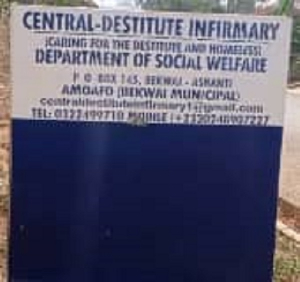 One of the health centres the reporter visited