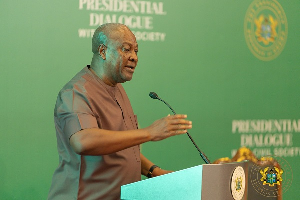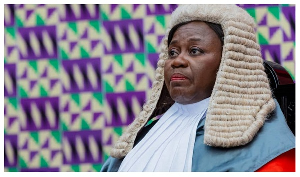
The announcement by the Minister for Government Communications, Felix Kwakye Ofosu, that President John Dramani Mahama has forwarded three petitions seeking the removal of Chief Justice Gertrude Torkornoo to the Council of State for consultations has sparked a flurry of reactions and ignited an uproar across the country.
The move which is in accordance with Article 146 of the 1992 constitution and outlines the processes involved in the removal of justices of superior courts and chairmen of regional tribunals has equally divided legal opinions.
Arguments, particularly regarding the constitutionality of the president initiating the move and the request by the CJ for copies of the petition, have become the main focus of the debate.
Some legal experts and practitioners have presented arguments supporting the process initiated by the president, while others have raised objections to it. What are they saying?
Arguments raised by lawyers for the motion of the CJ’s removal:
Prof Stephen Kwaku Asare
Also known as Kwaku Azar, the legal scholar shared his insights on the Chief Justice's request for copies of the petition from the president. He stated that, until a prima facie case is established, the public officer—in this case, the Chief Justice—who has been petitioned against, has no constitutional right to be heard.
According to him, there is a risk of politicizing the entire process as outlined in the constitution, which could compromise its integrity.
“Under Article 146 of the 1992 Constitution, public officers occupying certain high constitutional positions can only be removed from office through a carefully structured process designed to balance accountability with fairness. Central to this framework is the requirement that a prima facie case be established before a full investigative committee is constituted (see Agyei-Twum v Attorney-General [1998-99] SCGLR 732).
“This threshold determination is not a trial, nor an inquiry. It is a constitutional filter—an initial check to determine whether the petition is serious enough to warrant a full investigation. And because it is purely preliminary and administrative, the public officer petitioned against has no constitutional right to be heard at this stage. This is deliberate,” he wrote on Facebook.
He added, “Allowing a response before a prima facie determination would not only collapse the two-stage process into a single, premature inquiry—it would invite a back-and-forth: a response, a counter-response, a rebuttal—all of which are the hallmarks of an inquiry.”
Thadeus Sory
Another legal practitioner, sharing his views on the matter, particularly regarding the injunction suit filed by some individuals seeking the Supreme Court to declare the president’s move unconstitutional, stated that the president did not err and that his action was constitutional, as outlined in Article 146 of the constitution.
“… only Article 146(6) is relevant in determining whether the President was required to seek the Chief Justice’s comments before consulting the Council of State. Article 146(6), in clear and unambiguous terms, states that when a petition concerns the removal of the Chief Justice, the President must act in consultation with the Council of State.
“The law requires that the President act in consultation with the Council of State. That consultation is currently ongoing. Let the process unfold. The Council of State has its own esteemed legal minds—trust them as much as you have always asked us to trust you.”
Samson Anyenini
In his view, Anyenini referenced past precedents set in similar cases and expressed the opinion that the Chief Justice is not obligated to have access to the response of the respondent.
"Prima facie - What is prima facie in Latin? Prima is primus and means first and facie refers to face. To the trained, this quasi judicial but administrative function of the CJ is that simple to do – first impressions from looking at the petition.
“The Oxford Law Dictionary deals with prima facie evidence as presumptive and defines it to be; (1) “evidence that is sufficient to discharge the burden of proof borne by a party and that may be sufficient to discharge the persuasive burden of proof if no evidence in rebuttal is tendered.” Or (2) “evidence of a fact that is of sufficient weight to justify a reasonable inference of its existence but does not amount to conclusive evidence of that fact.”
He added, “The CJ is not under obligation to have the response of the respondent (accused), but they (CJs) have created a precedent of first forwarding the petition to the respondent for his/her response to the allegation(s) made by the petitioner before determining whether it is worth inquiring into by setting up the five-member committee as dictated by article 146(4)."
Martin Kpebu
The private legal practitioner stated that the president is not obligated to seek a response from the Chief Justice before making a prima facie determination on a petition for removal.
“In order to make that prima facie determination, you don’t always need the response of the Chief Justice or any other justice of the superior courts,” Kpebu explained in an interview on JoyNews’ The Pulse.
He, however, clarified that while the president has the discretion to assess whether a petition has merit at the initial stage, due process must still be followed.
“What the president cannot do is find merit in a petition and refuse to hear from the Chief Justice before proceeding to the second stage, where a tribunal would be formed,” he emphasised.
Arguments raised by lawyers against the motion of the CJ’s removal:
Ansa-Asare
Kwaku Ansa-Asare, a former Director of the Ghana School of Law, voiced his opinion on the matter, stating that he would not have requested copies of the petition if he were the Chief Justice.
However, he acknowledged her actions, emphasising that they reflect her understanding of the law.
“If I were the Chief Justice, I wouldn’t have even asked for the copies. But the fact that she has requested them shows that she knows the law and understands that she is entitled to them,” he said.
He explained that the CJ’s request is in line with what the law stipulates.
“The law is clear—if a petition is sent against the Chief Justice, she must know what it says. That’s why she wrote to the President requesting her copies.”
However, he argued that the Chief Justice did not necessarily need to make a formal request.
“Even if she hadn’t written to the President, she should just continue her work. The Council of State will ask if she has been given copies, and if not, they will direct the President to provide them,” he added.
Kow Essuman
Kow Essuman, former President Nana Akufo-Addo’s legal counsel under his presidency, has urged President John Dramani Mahama to uphold the rule of law in the ongoing controversy surrounding the Chief Justice’s removal process.
In a statement addressing the matter on March 27, 2025, Essuman expressed concern over the Chief Justice’s inability to access the petitions filed against her, which form the basis of the President’s consultations with the Council of State.
“I have seen lawsuits filed in the Supreme Court and a letter from the Chief Justice addressed to the president and the Council of State. The main point of these documents is that the Chief Justice has yet to receive these ‘so-called’ petitions lodged with the President, which form the basis of the ongoing prima facie determination consultation between the president and the Council of State,” he said.
He cited a 2016 Supreme Court ruling in Dery v. Tiger Eye P.I. to emphasize the importance of granting the Chief Justice a fair hearing before any determination is made regarding her removal.
“The rules of natural justice and the right to a fair hearing dictate that the Chief Justice should at least be given an opportunity to respond to the petition before a prima facie determination is made.”
I have seen lawsuits filed in the Supreme Court and a letter from the Chief Justice addressed to the President and the Council of State. The main point of these documents is that the Chief Justice has yet to receive these “so-called” petitions lodged with the President, which…
— Kow Essuman (@kaessuman) March 27, 2025
Richard Dela Sky
The legal practitioner, who also appears to support the CJ’s request for copies of the petition seeking her removal, referenced precedent cases that aimed to provide clarity on the concept of prima facie.
“Commonsense could even be brought to bear on this interpretation—that the framers of the Constitution could not have intended that even before prima facie determination has been made, or before the committee has concluded its investigations and submitted its report, the whole world should be told of the contents of the petition. That would clearly be defeating the purpose of the confidentiality and privacy that is required to attend to such proceedings.”
MAG/EK
Meanwhile, watch this concluding part of our sit-down with the 100-year-old World War II veteran, who was also present at the 28th February Shooting, below: