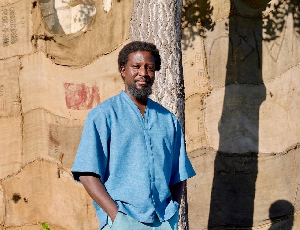
If there is one Ghanaian who has been putting Ghana on the map consistently over the past few years, it should be Ibrahim Mahama, a visual artist and Chief Executive Officer (CEO) of Red Clay, Savannah Centre for Contemporary Art, and Nkrumah Volini.
Ibrahim Mahama, who has recently been awarded a diplomatic passport, has won several awards and made international news headlines because of his work transforming “waste” into wonderful artefacts.
All the awards, international recognition, and diplomatic perks could not save the CEO of Red Clay from being manhandled to the extent of losing his teeth, allegedly by the police, less than a year after he was adjudged the “most influential figure in global art”.
Well, if there is one person who has “power” and an international connection to put pressure on the government to ensure that the police unit accused of brutalising him, the Black Maria, are punished, it should be Ibrahim Mahama.
The Political Twist, Death Threats and More: Ibrahim Mahama gives details of alleged assault by Black Maria
Here is what you should know about Ibrahim Mahama:
In December 2025, the Ghanaian contemporary artist emerged as number one amongst 100 people on the 2025 ArtReview Power 100 list, the first African to achieve such a feat. The Power 100 is ArtReview's annual portrait of power in the art world. It is an attempt to describe the individuals and groups that have shaped what and how art has been seen in a year.
Ibrahim Mahama is known for his large-scale installation, sculpture, and architectural interventions that explore global change, commodification, labour, economic inequality, migration, and the socio-political legacies of colonialism in Africa.
He transforms everyday materials, such as jute sacks used in commodity exchange and abandoned infrastructure, into works that engage with collective memory and historical narratives.
Ibrahim Mahama has exhibited internationally, including the Venice Biennale in Italy, Documenta in Germany, the Biennale of Sydney, and other major museums across Europe.
His work is held in public collections worldwide, including the Centre Pompidou, the Los Angeles County Museum of Art (LACMA), and the National Gallery of Art, Washington.
Here is a write-up by ArtReview on Ibrahim Mahama after he was adjudged the most influential person in the contemporary art world in 2025:
The Physical Impossibility of Debt in the Mind of Something Living (2025), a new work made for Mahama’s solo show at Kunsthalle Wien, features a hollowed-out diesel locomotive, originally purchased by Ghana from Germany and the UK via IMF loans to carry goods for export, sitting atop several thousand headpans – a traditional method of transporting goods in Ghana.
It is a typically neat entanglement of capitalism and waste, colonialism and neocolonialism, that the artist has made his own, utilising industrial scrap, from textiles to shoemaker boxes, from rusting hospital beds to large-scale infrastructure, in his sculptures and installations.
Mahama came to prominence in his use of jute sacks and remnant textiles – leftover cloth from Ghana’s cocoa industry, later used to hold vegetables and coal – stitched together by teams to form oversized quilts he has draped over buildings, from the former Food Distribution Corporation building in Accra to London’s Barbican Centre. This year, he also wrapped the exterior of Kunsthalle Bern and MoCA Skopje, disguising architecture while foregrounding industry and labour, and took part in November’s Thailand Biennale in Phuket.
His solo exhibition at the new Ibraaz space in London was a proposed meeting space, gathering chairs from Ghanaian households on a platform made from wood reclaimed from Ghana’s colonial railway system. His shows often evidence the links between disparate locations, the materials as traces of global trade routes, and extractivist politics within which we have long been intertwined.
Mahama’s aesthetic shares its roots, more immediately, with artists such as fellow Ghanaian and key influence El Anatsui, or a wider pool that might include Subodh Gupta or Melvin Edwards, where yesterday’s detritus becomes potent symbols for today’s continuing inequalities.
But his presence at the top of this year’s list is also for his role as an institution maker. The question of who benefits from Ghanaian labour has led Mahama to question the art market too, resulting in his decision to plough his blue-chip-sales profits into a series of institutions in his hometown of Tamale: the Red Clay Studio, the Savannah Centre for Contemporary Art (SCCA), and Nkrumah Volini, which act as open studios and sites of production, as well as hosting residencies, student projects, children’s workshops, and exhibitions. SCCA this year hosted The Writing’s on the Wall, a group show curated by blaxTARLINES member Robin Riskin, and partnered with Michael Armitage’s Nairobi Contemporary Art Institute for the collaborative exhibition Notes on Friendship: Breaking Bread. Red Clay Studio’s site is peppered with old planes now used to hold workshops with students, and the husks of trains that feature in Mahama’s exhibitions.
The artist has often spoken of making use of the contradictions inherent in his own art production and distribution towards efforts of redistribution. With workshop-led projects taking shape for December’s Kochi-Muziris Biennale and next year at the MAPS Museum in Køge, Denmark, alongside a forthcoming show of work in Singapore, Mahama continues to pose questions of what art does and who it is for, with no single answer.
Between these sites and activities, Mahama is offering the role of the artist as a localised institution builder, arts educator, and community advocate, drawing on the proclivities of the international art world to fuel, but not guide or determine, what art might otherwise be. As old models of museums and galleries continue to struggle, the potential of new forms for the support and distribution of art, whether as formal institutions or shifting hubs, are key issues for the present and near future that Mahama is helping to shape.
BAI
General News of Tuesday, 24 March 2026
Source: www.ghanaweb.com