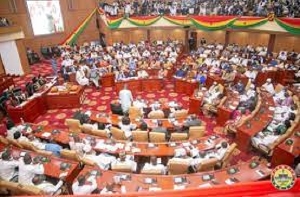
President John Dramani Mahama, opening the 13th High-Level Dialogue on Democracy, Governance and Human Rights in Accra, on Tuesday, July 29, called for a decisive action on reparations for Africa and stressed the need for the declarations made under the African Union’s Decade of Reparations to be implemented with urgency and purpose.
He said Africa must take firm ownership of its reparatory justice agenda, especially where the next decade had been designated for that critical task.
He said, “2026 to 2036 has been declared as the decade of reparations by the African Union. I also wish to commend the Executive Council for approving the terms of reference for the African Union Commission of Experts on Reparations and the African Union Reference Group of Legal Experts on Reparations."
The Minister of Foreign Affairs, Samuel Okudzeto Ablakwa, in his opening remarks, called on African countries to close ranks and turn the reparations advocacy into concrete results.
He reiterated the country’s commitment to supporting African-led initiatives aimed at addressing the lasting legacies of colonial injustice and exploitation.
He said that campaign was long overdue, hence the need for Ghana to take proactive steps to become a leading voice in promoting fairness, restoring dignity, and reclaiming control for African nations still dealing with the effects of colonial rule.
“We are a country defined by our eternal struggles against the transatlantic slave trade and against neo-colonialism. For us, justice, human rights, and good governance is a deliberate and conscious resolve. You’ll find it in our DNA,” he stated.
Veteran journalist and Member of the Coordinating Committee of the Pan-African Progressive Front (PPF), Kwesi Pratt Jnr, has argued strongly that Africa has no obligation to repay loans granted by imperialist nations since such financial arrangements were never designed in the best interest of the continent.
According to Pratt, such loans were not intended to benefit African citizens but rather to reinforce the geopolitical interests of donor countries as the structure of those loans further disadvantaged African nations.
Speaking during a plenary discussion on the second day of the 13th High-Level Dialogue on Democracy, Governance and Human Rights in Accra on Wednesday, July 30, Pratt challenged the legitimacy and moral grounding of such debts.
“I will begin with a quotation by Thomas Sankara; ‘Most of the debts which have become burdensome for the African people are not debts that ought to be paid. These are unpayable debts. All of us do know that if you don't follow the dictates of the West, you get nothing. So aid, loans, and all have become instruments of foreign policy of the imperialist countries.
“And if they're instruments of foreign policy of the imperialist countries, why are we then called upon to pay?” he questioned.
Citing historical examples, he referenced the United States’ support for Mobutu Sese Seko’s regime in former Zaire (now Democratic Republic of Congo), noting that despite knowing the loans were unpayable, the West advanced them to serve their own Cold War interests.
“For example, all of us do know that you take a loan from any of these countries and you are required to use contractors from those countries. You take a loan from these countries, you are required to buy all the equipment you need from those countries and so on; so these loans are just recycled.
"They come here and they go back to the countries where they came from. And yet we are supposed to work our backs to pay these loans that did not benefit us in any way,” he explained.
Kwesi Pratt Jnr, who was in his elements, also used the platform to urge African journalists to play a more assertive role in transforming the narrative on the continent.
He called for a new wave of journalism that spoke truth to power and confronted global injustices.
“We should be promoting the kind of journalism which sees the genocide which is being committed in Palestine, in Gaza, and which sees that genocide which is being committed there is not substantially different from the genocide which was imposed on us through the transatlantic slave trade,” he said.
He further stressed the need for a journalism that respected the founding principles of the Organisation of African Unity (OAU) and its successor, the African Union (AU), especially in upholding opposition to all forms of colonial occupation and foreign interference.
“We need to provide journalism which sees all of us as people fighting for survival against disease, fighting for survival against hunger, fighting for survival against the vagaries of the weather… A new journalism which aims at building an entirely new world, a world which denounces militarism, a world which denounces the utilisation of the limited resources of the world to provide weapons of mass destruction,” he said.
Concluding his remarks, Pratt boldly called for the elimination of all foreign military bases from African soil.
“We need to develop a new kind of journalism which is opposed to the presence of all foreign military bases on African soil; all foreign military bases --- French, American, British, NATO — all of their bases have to be taken out of Africa so that the African people can pursue their own path of development and prosperity.”
The two-day Dialogue, themed, "Justice, Rights, Reparations, and State Building", was organised by the African Governance Architecture (AGA).
It attracted heads of state, diplomats, civil society actors, academics, and human rights advocates to examine the foundations of African development through justice and equity.
The Accra forum was a follow-up to the recent 7th Mid-Year Coordination Meeting of the African Union held in Malabo, Equatorial Guinea, which marshalled all African countries to unite in the reparations fight.
General News of Thursday, 31 July 2025
Source: Edith Mensah, Contributor
Africa not indebted to imperialists - Kwesi Pratt Jnr
 Kwesi Pratt Jnr is a veteran journalist