African countries are grappling with disproportionately high borrowing costs, with interest rates surging to 8.2 percent in 2024. This marks a sharp increase compared to the average range of 5.4 to 6.3 percent recorded between 2008 and 2019, according to a new report by the African Development Bank.
These elevated rates have significantly increased debt-servicing obligations, forcing governments to divert scarce public resources away from critical social and development priorities.
Analysts attribute the trend to structural asymmetries in the global financial system, including credit rating biases, limited access to concessional finance, and the absence of a fair, rules-based sovereign debt resolution framework.
This has constrained African governments’ ability to manage shocks and respond to crises, deepening reliance on costly debt and undermining long-term sustainability.
Domestically, weak public financial management, capital flight, illicit financial flows, fragile taxation systems, and ambitious fiscal and public investment plans have further fuelled the continent’s debt challenges.
Speaking at the Sixth Edition of the AFRODAD Media Initiative (AFROMEDI VI) in Nairobi, Kenya, the Interim Executive Director of AFRODAD, Dr Yungong Theophilus Jong, urged journalists to play a watchdog role by holding governments and creditors accountable.
He stated that many debt contracts are shrouded in secrecy, making media scrutiny essential.
“When the public watches, things change. When voters ask questions, politicians answer. When citizens understand what was promised in their name, they demand accountability. And when journalists illuminate what would otherwise remain hidden, the powerful can no longer act with impunity,” Dr Jong said.
He added: “A continent that tells its own story sets its own terms, and holds its own leaders and the world accountable.”
AFROMEDI VI, themed “Partnering with Media to Advance Socio-Economic Justice and Africa’s Common Position on Debt,” seeks to strengthen the capacity of African journalists to interrogate sovereign debt structures, private creditor influence, and global financial governance systems.
Since its launch in 2021, AFROMEDI has trained more than 600 journalists from 37 African countries, contributing to more informed public discourse and sustained media engagement on debt, fiscal justice, and economic governance.
This year’s edition aims to deepen media engagement with continental policy frameworks and African Union debt reform processes, including the Lomé Declaration on Debt.
It also seeks to equip journalists to humanise debt issues through people-centred storytelling.
AFROMEDI VI was organised by the African Forum and Network on Debt and Development (AFRODAD) in partnership with Transparency International Kenya and the Stop the Bleeding Campaign.
SA/BAI
Business News of Thursday, 28 May 2026
Source: www.ghanaweb.com
AFRODAD pushes media accountability over Africa's escalating borrowing costs
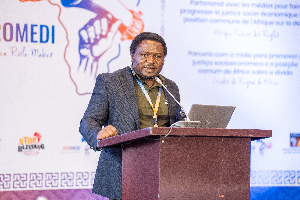 Dr Yungong Theophilus Jong is the Interim Executive Director of AFRODAD